
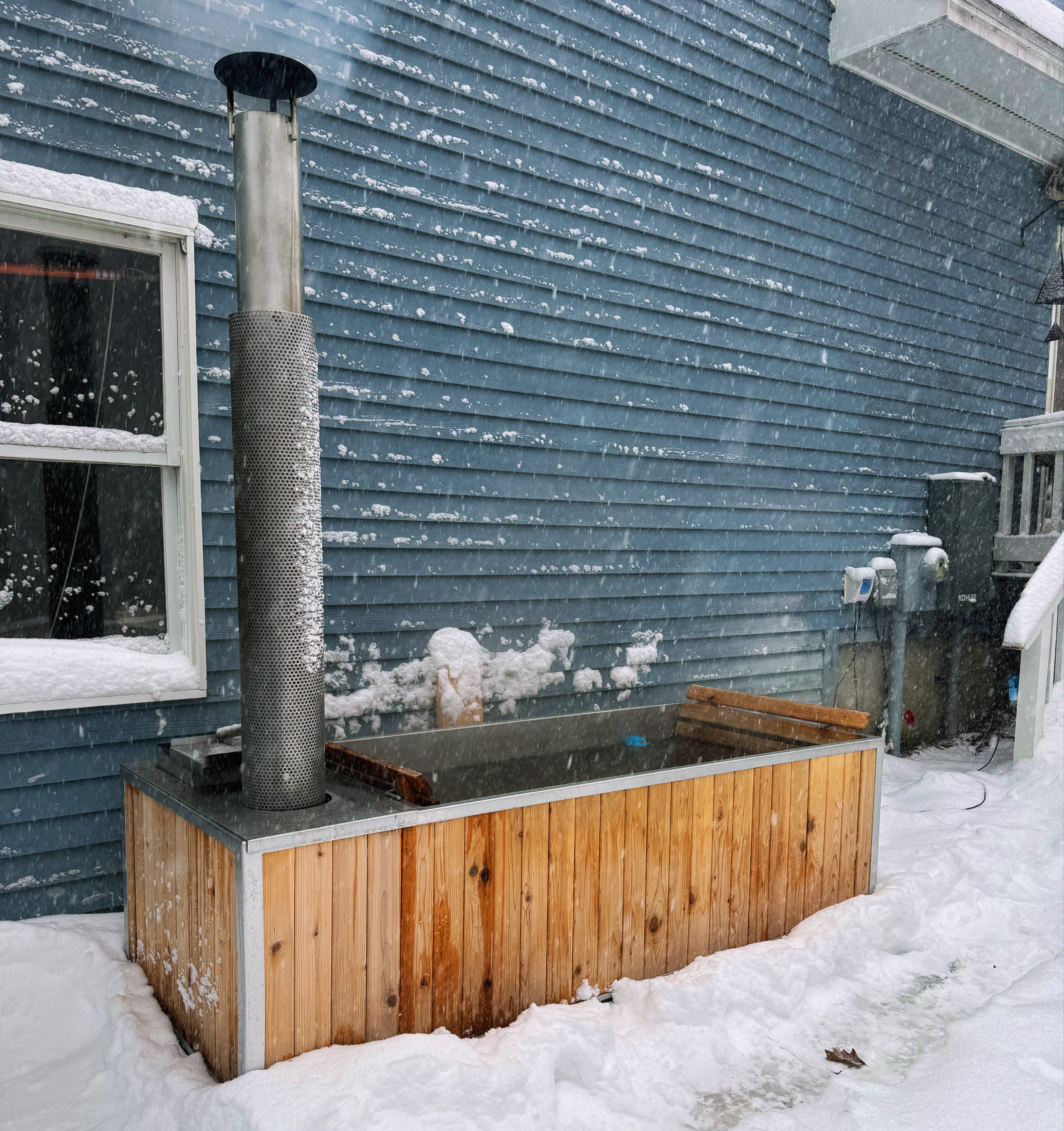
About a year ago, we bought a wood fired hot tub – specifically this one from Goodland. We love it and use it every day it doesn’t rain and some days when it does. And It’s utterly amazing in the snow. Anyway, for those that want the background, I went through our thoughts around buying the tub and our initial experience in a lot more detail here.
When I wrote it up, however, I promised to follow up with details on how we treat our water. To do that, I’m going to lay out our process for filling and treating the water in our Goodland. For those of you in the same boat as we are, then, hopefully this is helpful.
Why treat the water at all?
We save time not repeatedly filling and draining the tub – not to mention saving water – but mostly we treat our water because we’re on a well. It’s a good well and reasonably deep, but we don’t want to overtax it. The average bath tub is something like 50 gallons. The Goodland is around 250. If you filled it every day, in other words, it’d be like taking five baths a day – not that you’d have to. You can usually get at least a week out of a given fill even untreated. We’d probably be fine, then, but when it’s the water source for our primary and only residence, why take chances?
If you’re on city/town water or if you have a handy source of water nearby – creek, river, lake or ocean – that will unquestionably be easier to do.
But for us, treating the water in our Goodland makes the most sense.
How is the water treated?
There are two components to our water treatment approach: chemical and filtration.
What’s filtration?
It’s not enough to just treat the water with chemicals to keep it bacteria free. Even if you have both covers for the Goodland as we do, you’re going to get debris in there: leaves, pollen, ash, insects and so on. You can’t easily remove those via chemicals.
What do you use for filtration?
The bad news is that I have yet to find a perfect solution to this problem – there just aren’t many commercial options available. My assumption is that there’s not a major market for external hot tub filtration systems because the majority sold come with inline filter equipment built in. Whatever the case, you basically have two options: internal units that sit in the tub, or pumps that sit outside of it.
There are many more external options than internal ones, and they’d be much easier to integrate. We ruled those out, however, because we use our tub heavily in the winter and an external filter is much more likely to freeze.
So instead we got an oversized combination filter/skimmer unit intended for above ground pools. Specifically, we got a Bestway Flowclear 680. It’s too big for the tub, I have to clamp it into place and you have to remove it to fit more than two people in, but that’s a thirty second chore.
And the upside to having the filter in there is that it automatically circulates the water as it heats up, so I don’t have to keep mixing it with the Goodland paddle.
Do you still have to clean the tub manually with a skimmer net?
Yes. The Bestway’s filtration system is better than its skimmer function. But skimming a hot tub the size of a Goodland is not like skimming a regular sized pool; it doesn’t take that long at all.
Ok, so what about chemicals?
While I’m no expert, and there are alternatives, the most common two options for chemical treatment are bromine and chlorine. Bromine is a little gentler and has less odor, but is more expensive. Chlorine is a little harsher and you get a faint chemical smell, but it’s cheaper.
We opted for chlorine, but via a salt water system.
What’s a salt water system?
For this system, you add pool salt to regular water to achieve a salinity level that is substantially lower than seawater, but still feels softer and gentler on the skin. An electrically powered salt water system then uses the salt in the water to generate more consistent, lower levels of chlorine than is typically found in a hot tub which makes for a gentler experience. I was sold on the Salt Water idea by this video from Swim University.
As for which system, we use the Saltron Mini for our Goodland.
Can the Goodland handle salt water?
Yup, there’s no issue whatsoever. Neither the aluminum nor the cedar are impacted by salt water.
One caveat, however: if you use your Goodland in the winter and you use a salt water system, do not buy the pond de-icer that Goodland recommends on their website. The stand for it is steel and it will rust immediately and stain the cedar it sits on and color your water.
How does the treatment process work?
Let’s divide that into stages. There’s the initial fill, and then there’s the ongoing maintenance.
The fill is very straightforward. You simply filter the incoming water; for that, we use one of these attached to our garden hose. In our case, it pulls out the iron and other minerals present in our well water.
The filter doesn’t slow the process when it’s working – it takes us about an hour to fill the tub. That filter is rated for a couple of thousand gallons before it’s shot, but ours slowed to a trickle after two or three fills. Turns out if you shake it a couple of times, performance goes right back to normal.
What about ongoing maintenance?
That can be divided up into three parts: skimming, filter maintenance and chemical treatment.
If you’ve ever been around pools, skimming is simple: it’s a mesh net that you use to fish medium to large debris – i.e. leaves, bugs and so on – out of the tub. With both covers on our tub, I have to do this maybe once a week. Twice in the summer.
How about the filter maintenance?
That’s also not that complicated. Changing the filter on the Bestway is a thirty second chore. The filters last a couple of weeks, and when you notice reduced flow out of the unit you turn it off and pop in a new filter.
Lastly, what about chemical treatment?
Once you get past the initial setup, treatment is very simple. Our Ph, hardness, salinity etc doesn’t tend to change much once it’s established.
But out of the gate this one’s more complicated and depends on your water composition. The first thing you’ll need is test strips. We use two types: this one to test Ph, alkalinity, chlorine, hardness and so on and then a second to test salinity.
Incidentally, I do not recommend this test unit: it’s slow to read and the results tend to vary pretty widely from our strips.
What is the first thing to add to the water?
The first thing we add is salt. Our well water obviously has no salt in it to start. Our Saltron system is optimized for 2000-2500 PPM salinity (by comparison, seawater is 35,000 PPM). To get to that level, I add 5.25 lbs or 2265 grams of pool salt. There’s no chemical difference between pool salt and table salt, apparently, but it’s optimized for quick dispersal and dissolution.
What comes next?
Next comes adjusting the alkalinity. Out of the well, ours is 80 PPM. To get to the recommended 100 PPM, we add 2.5 tbsp of alkalinity increaser. Notably, that’s a Spaguard product, and that’s what we use across the board a) because it’s designed for hot tubs and b) it’s easy to adjust the doses to a Goodland sized tub.
After getting the alkalinity where we want it, there are just two more adjustments to be made before getting to the all important chlorine.
First, we adjust the Ph. Our water is 7.2, and we want to get to 7.6. To do that, it’s 2.5 tsp of Ph increaser.
Second, we need to add calcium to the water to make it harder. Our well water is zero PPM, so we add 14 grams of calcium hardness increaser.
How does chlorine treatment work?
The Saltron system mostly takes care of this on an ongoing basis, but it’s like a battery trickle charger – it can’t establish the baseline chlorine level on its own, it can only keep it topped off.
So after taking care of the rest of the water chemistry, we add 1.5 tsp of Spaguard chlorinating concentrate. That gets us to a 3+ chlorine level and then the salt system takes it from there.
If the tub is exposed to the sun which destroys chlorine, or if the salt system is left off for a period of time, your chlorine may go back to zero in which case a reapplication of 1.5 tsp is required.
What other chemicals are necessary?
Every so often, most often following heavy use, heavy rain or some combination of the two, the tub begins to get cloudy. At that point, we “shock” the tub using this enhanced shock product. I believe the dosage is 4.5 tsp for the Goodland, but definitely check my math on that before applying it.
Whatever the dose, applying this once a week or every other week keeps the water very clear.
How long will a given fill with the above treatment regimen last?
As a rule we cycle our water after six months, but typically it’s still clear at the time we do that. We’re also pretty strict, however, about being clean and showered before we get into the tub.
How much time does the above maintenance take on a weekly basis?
Not more than an hour. The only things that are really required regularly are skimming, testing and correcting the chlorine if necessary. Everything else is mostly an up front setup cost in time.
Anything else to add?
Just be aware that all of the above measurements are specific to the water chemistry of our well – you’ll want to adjust the amounts to your particular water source.
Is treating the water worth it?
Easily. First, it keeps our well safe and unstressed. Second, it’s really not that much work on a weekly basis. And third, once you have your doses dialed in, it’s just not that complicated to treat your water.
In a perfect world, we’d be pumping creek water or seawater in for every soak, but given that those aren’t options for us treating it is the next best thing.
 sogrady.org