So I Built (Another) Woodshed
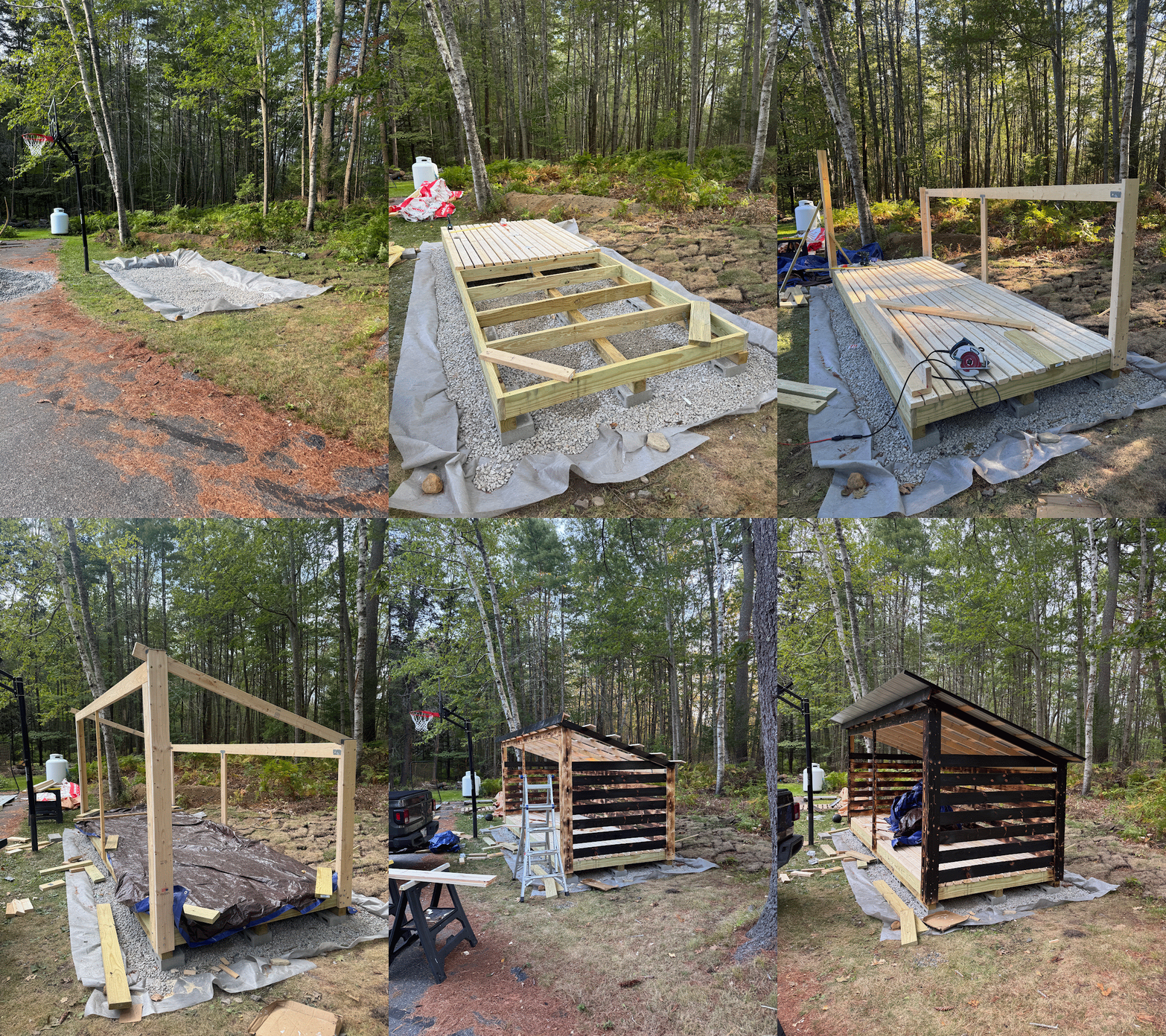
Eleven years ago, I built a woodshed at our old house. Mistakes were made, but overall it did what it was built to do, and I learned a lot in the process. Five years later we moved to the island, and the new house came with its own woodshed.

The shed we inherited had two major issues, however. First, it was too small for our usage. Between the wood stove, the Solo fire pit and most recently our wood fired hot tub, we go through something like five plus cords of wood per year, and this shed stores maybe two. The bigger problem, however, was that it’s simply old and falling apart. I considered trying to shore it up to buy another couple of seasons worth of service, but it’s compromised to the degree that that would be a waste of time.

For two years, then, while we tried to figure out next steps, we simply stored our wood in the driveway. This has been a nightmare for several reasons: the wood isn’t kept dry, it can be impossible to get at in the winter when a foot of snow freezes like a shell on top of the covering tarps and it looks like absolute crap. Also, everything from squirrels to snakes ends up nesting in there.

Anyway, over this past spring we finally arrived at a household consensus not only for what kind of shed to build but where to put it. Mostly so that I didn’t have to generate a cutlist, I picked up a set of plans off Etsy for $20. Instead of a two cord shed, we decided to build a larger four cord shed to accommodate the volume of wood we typically go through.

To do this, we had to move it. Our current shed is right by the door to our great room where the wood stove is, which is convenient for bringing wood in in the winter but inconvenient to load from the driveway. The new shed was too big for that spot, and is instead across the driveway, which means that I’ll have to bring wood around by cart. That’s not ideal, but it will be much easier to load in when the firewood is dropped off.

With all parties finally in agreement, I made plans to get to work this August while on vacation. And that’s when things started to go wrong.

Permitting

Being married to a lawyer means that you have to do everything by the book which means getting literally everything permitted. Even a woodshed. When I contacted the town about getting one for the planned new shed, they told me there was actually no permit for our old shed. Which I assume means that whoever built the shed was neither a lawyer nor married to one.

The town permitting took a month, but otherwise proceeded without incident. Then Kate worried about the vernal pool setbacks – again: lawyer – and that triggered multiple rounds of interactions with the town and state. Shockingly, however, we eventually got the go ahead – the only catch was that I had missed my best window to build, which was a week in which I was on vacation but Eleanor was in camp.

But by carving out a few hours here and there, I gradually got to work. Which brings me to the footprint.

Footprint

When I built the shed at our old house, I built it on grade, which is to say I dug down ten inches, filled the area with crushed stone and put concrete pavers on top. This was miserable and in my writeup I recommended against on grade in favor of poured concrete footings.

And that was indeed my plan, until I realized that I had no way of knowing definitively where precisely our water line ran. Faced with a choice between an on grade foundation which wouldn’t dig deeply enough to hit the water line (not so much for the fiber line, alas) or concrete tubes that may or may not cut off the water supply to our house, I did what I had told myself last time not to do.

The bad news was that this new much larger shed required a new much larger footprint than the last time I’d gone through this exercise. I had to remove over five cubic yards of dirt, sand and clay and replace it with over five cubic yards of crushed rock. The good news is that my nephew was looking to pick up some pocket money and had a couple of spare days before he headed off to school. Eleanor helped as well, so I at least didn’t have to do this part on my own.

Once the crushed rock was in place, I had to put in the pavers the shed’s skids would sit on. There were fifteen in three rows. Each paver needed to be level by itself, and level with its neighboring pavers and with every other paver on the grade. Long story short, this work was tedious, fiddly and absolutely miserable. But it eventually got done. Next up was building the foundation.

Foundation

The foundation for the shed was three skids of 16’ pressure treated (PT) 4×4’s, on top of which was placed a frame of PT 2×6’s. This was easy enough to assemble, but when I checked it for square it was off by several inches. Which meant a trip to the hardware store to buy a ratchet strap which temporarily succeeded in making my frame square but did so by cracking and ripping out the bottom of one of my end joists. Which in turn meant a trip back to the lumber store to get a replacement 2×6, and to install it I had to essentially take the entire frame apart and put it back together. And when I did that, I checked it for square and I’d somehow made it worse.

One more application of the ratchet straps – more carefully this time – and some temporary braces and I ended up with a rectangle rather than a trapezoid. As I laid down the flooring – regular 2x4s rather than cedar for cost reasons, and we’ll see how that ages – I could remove the braces and it held square.

Onward.

Posts

Next up were the shed posts, composed of two 2×6’s. I thought it would be a pain in the ass to level and plumb these without a second set of hands and I was right. But using spare lumber as braces, I eventually got all four posts up, then connected by cross-beams.

While the posts wrapped around the corners of the foundation as two 2×6’s joined as an L, they didn’t offer much strength front to back. So it was time for rafters.

Rafters

Before building, I had Claude look at the plans and it told me the pitch for the rafters should be 4 to 1. Measuring out the instructions using a speed square, it was 5 to 1. Not sure which to go with, I defaulted to the original plans over AI’s interpretation of them and it worked.

In the last eleven years, however, I have not gotten a lot better at cutting out bird’s mouths for rafters and they were a bit rough. (Side note for future me: don’t use the circular saw, go with a jig saw – and try not to snap its blade off mid-process). The warp on several of the rafters didn’t help either. But eventually I got all the rafters up. And the purlins on top of them running perpendicular.

And then it was time for siding, and that’s when things got interesting.

Yakisugi / Shou Sugi Ban

In my last shed, the siding was all cedar for its weather resistant qualities. A decade later, with a much larger shed, that lumber would run 2-4X the cost of the more basic pine. But the pine would rot much more quickly – unless, that is, it could be made weather resistant via the Japanese technique known as yakisugi or more commonly shou sugi ban here in the US.

Basically, this means burning the exterior of the wood to render the charred surface much more resistant to weathering.

The traditional method for this is using three planks to form a triangle, and burning the middle, rotating the triangle up and down to allow the fire to burn the length of each plank. This requires skill, technique and experience that I did not have. So instead I borrowed a flame thrower from one of Eleanor’s friend’s moms.

This past weekend, then, while the girls were away, I laid out all of the siding in the driveway, and systematically burned it all using the flame thrower. You can lightly burn wood, but in search of the best weather resistance and a preference for a darker shed, I opted for a much deeper level of char. Except for knots and some patterns in the wood, the siding is now a deep black.

After doing the siding, I next took the flamethrower to the shed, burning the posts, the beams and all of the non-PT wood to protect it. This has led to some questions in the household about why the foundation isn’t black, but given that burning PT wood releases toxic fumes they’re not going to get the yakisugi treatment. Instead, I’ll probably turn to some sort of stain eventually to have the shed be more aesthetically consistent.

As not fun as leveling the pavers was, the act of burning this wood was a delight. Using a flamethrower on its own is entertaining, but seeing flame interact with the wood, revealing and then obscuring the grain was wild. Best part of building the shed by far.

As an aside, to the couple that walked by the top of the driveway and then more or less sprinted off when they saw me laying down swaths of fire, sorry if I freaked you out.

Roof

The only things left to do after applying the siding were fitting the drip edge and roof panels on. It took some persuading at home, but I eventually got the go ahead to use corrugated metal for the roof rather than plywood, felt paper and asphalt shingles. Given how terrible the experience of roofing was last time, this was a big win. I’ve even got extra panels if/when these get damaged. Other than putting in the top couple of rows of screws, which was at the very limit of my ladder, the roof wasn’t difficult to put on. We’ll see how it ages, but it is far easier to install than a traditional shingled roof.

Lessons Learned

  • A pickup bed makes a fantastic mobile equipment shed. Last time I took over our dining room table. This time around I just kept all of my tools in the back of the pickup, and backed it up to the worksite when it was time to build.
  • Having help – particularly for moving thousands of pounds of dirt and crushed rock – is pretty great. Shout out to Eleanor and my nephew for their help. No shout out to Sully, who continued his standard practice of picking the least convenient place possible and lying down.
  • I knew this going in, but it was even worse than expected, but budget extra time for extra trips to the hardware store. Even though Hancock delivered all of the necessary lumber and fasteners to the house, mistakes in ordering, mistakes in the cutlist or simply mistakes that break things mean extra trips to the store. I conservatively was in Ace Hardware half a dozen times, Hancock twice and Home Depot three or four – twice on Saturday alone.
  • Internet woodshed plans are worth what you pay for them. I bought $20 plans and they were definitely worth $20. There were a few mistakes, instructions that were unclear and overall the plans were very basic. I tried to have AI upgrade them with a more detailed plan, but it just made different mistakes. In the end, it might have been simpler to adapt my own plans, but I really didn’t want to have to generate the cutlist from scratch for something this big and complicated.
  • With dimensional lumber, warping is a fact of life. I would have been better off, however, if I identified the most warped pieces ahead of time, because for the foundation in particular having the middle joist – on which the floor framing rests – be warped almost an inch and a half out of square was not particularly helpful.
  • Given that my day job is basically nothing but computers and video calls, building things with my hands offers an entirely different kind of satisfaction. Even if I spend half the time trying to recover from my own mistakes.
  • Maybe the most important takeaway – having used a borrowed Flame King unit, I need to get my own. Every house should have a flamethrower.

60 Miles

Over 1100 days ago, I went for a 50 mile walk. There was no particular reason for it. I wasn’t walking as part of an event, it wasn’t part of a group charity drive and it wasn’t to get anywhere. I never left my island, in fact. As someone who enjoys walking and walking long distances, it just seemed like a logical next step having walked a marathon distance six months earlier.

While I was wiped out and trying to recover from the grueling 14+ hour effort, my daughter innocently gave me an unintended backhand to the face with the simple question: “What’s next, Daddy, 80 miles?”

In the years since I’ve thought about her challenge, but ultimately arrived at the realization that the logistics of walking 80 miles are essentially the logistics of walking for 24 hours straight. People have done that and much more, certainly, but speaking as someone who doesn’t walk for a living it was a bit more than I wanted to take on. Instead, I picked a more realistic interim target: 60 miles. It’s a step up from 50, but more achievable for me at the present time than 80.

All that remained was picking the day, and then working up the mileage to try and hit that goal. As it turns out, yesterday was the day. Also as it turns out, that choice turned out to be a mistake, but I’ll come back to that shortly.

After an early bedtime Tuesday night, I was out our front door at 4:50 in the morning and hit 60.02 miles right outside that same front door at 12:34 AM. In the 18 hours and 55 minutes I was moving, I took 129K steps and burned just shy of 8K calories per my Apple Watch.

Anyway, that’s the gist of it. If you’re interested in the gory details – and honestly I’m capturing the rest mostly as documentation for my future self in planning future dumb adventures – feel free to read on.

The Weather

The last time I did a long walk, I did it in May. For a variety of reasons ranging from family illnesses to work travel, that didn’t happen this time around, and instead I picked the first day of July. For the record, even in Maine, if you’re going to be walking for a while outdoors, May is a better month to do it than July.

As with my 50 mile effort, I never left my island – assuming the little island connected to us by causeway counts as my island. Unlike last time, however, I couldn’t follow a pre-selected route because I had to change things up because of the weather. Out of all of the days I could have picked, I landed on one with “dangerous” heat warnings. I even had a pop-up thunderstorm scare at mile 57, accompanied by ten minutes of heavy, heavy rain.

Screenshot

The morning was relatively cool, so I followed a standard 16 mile route that I do from time to time. After that, however, I started opting for routes that offered tree cover. We have a trail that runs the length of the island, but it hasn’t been cut back recently and to reduce the tick threat, I used that sparingly. Instead, I spent the hottest hours of the day walking a loop in the preserve on the immediately adjoining island which offered not only good shade but sea breezes. After that, I had to make it up as I went along, and spent the last twenty miles basically walking up and down the main road on our island on repeat because my feet were shot and I needed as flat a surface as possible.

To be sure, “extreme” heat in Maine is just another day in, say, Atlanta, but with feels like temperatures in the mid 90’s and sky high humidity, I had to account for it in route and attire. Speaking of.

The Attire

My standard walking attire in the summer is a lightweight merino wool t-shirt, merino boxers, nylon shorts and synthetic socks. That’s exactly what I wore yesterday, except that I swapped outfits three separate times because I was soaked. Changing the t-shirt, boxers and so on wasn’t entirely critical, but dry socks are because wet socks can lead to blisters. Unfortunately, even with the sock rotation my feet were effectively destroyed by the end of the walk, in part because my socks were sweat through.

I also rotated through two different sets of HOKA shoes – one of which was brand new, but alas, that didn’t seem to make much of a difference.

The Feet

After my last long walk, for the last ten to twenty miles, it felt like the entire soles of both feet were one big blister. The good news is that when I woke up the next day, my feet were more or less recovered, and I was walking again two days later.

This year, however, while my left foot was mostly fine the day after, my right foot has a big blister on the heel and an even larger one on the pad of the forefoot. It’s damaged enough that I’ve been hobbling around all day, shuffling like a nonagenarian in an effort to put as little weight on the damaged foot as possible.

In a perfect world, day two will see significant improvement, but if not, I may have some tedious blister remediation work ahead of me.

The Pace

When I did my 50 mile walk, my average pace was under 18 minutes per mile. This time around, it was almost 19. A lot of that was the weather: I intentionally kept my pace easy so as to not overheat, and I had to opt for different routes as mentioned above for shade purposes which were slower going. Also relevant was that this was ten more miles than last time and I’m three years older. And maybe the biggest issue was the deteriorating condition of my feet.

In the end, however, I can’t say I care that much about the pace. I made it, and that’s what I care about.

The Sustenance

One of the important planning questions in walking a long distance is what to eat and when to eat it. Unfortunately, while there is a ton of information on nutrition for ultra-marathons, there isn’t a lot for walking. It’s an important distinction, because the delta in the caloric expenditure of running vs walking – even the kind of walk/running typical of an ultra-marathon – is significant.

What I landed on was a series of egg wraps throughout the day, with some gummies in between for quick energy and then a protein heavy pizza upon event completion. This seemed to work, in that I both had sufficient energy and that I had no digestive complications along the way. Which, if you read about ultra-running meal plans, sound pretty horrifying.

Anyway, the most important aspect for me particularly given the high temperatures and humidity was water. The night before I refrigerated both a Camelbak-style bladder and two 32 ounce water bottles – the latter two of which were filled with salt-laden electrolyte mixes. I went through all three of these by 5 PM, and cycled through the two water bottles twice each after that.

In a challenge like this, staying close to home is essential unless you have a support crew because there’s no way I could have carried all of the water I would have needed. Instead, I just rotated back through the house whenever I was out of water.

The Reward

My best friend and distance mentor – who recently completed an absolutely insane 100 mile, 10K vertical gain and 10 different species of fish challenge – has a tradition to close out long events with a big beer. Based on some back of the envelope calculations based on ABV requirements and my specific distance, I landed on Bissell’s Betwixt and Between as my celebratory beverage.

It was delicious, and had an outsized impact on my depleted system.

The Thanks

  • My Girls: first, and most obviously I need to thank Kate and Eleanor both for making a day like today possible, but more for putting up with all of the work that goes into it. I couldn’t do things like this without their support and understanding. Special additional thanks to Eleanor for my prized “GOOD LUCK DADDY BRACELET.”
  • My BFF: my primary inspiration for doing crazy things like this, I need to shout out my best friend Andrew for not only being my distance mentor on everything from what to eat and how to deal with blisters, but more importantly keeping me focused the last ten miles via constant text and talking me in for the last half mile. Appreciate you, friend.
  • My Island People: one of my absolute favorite things about walking on the island is the support I get from island people. From the little kid’s tiny thumbs up sticking out the window of a car driving way, to all the people who honk at me (most of whom I don’t recognize), to the people out in their gardens who stop me to ask how much I walk and tell me to keep it up to Terry, who sits out in front of his house and gives me a big wave as I pass. I felt nothing but support yesterday, even as I’m apprehensive about seeing someone post to our local town social media group asking about the guy who was walking up and down the main island road last night until the wee hours.
  • My Crow Friends: as some of you know, I’ve spent the past few years befriending local murders of crows all over the island. I feed them unshelled peanuts, and they welcome me wherever I go. To the point that a woman stopped me a while back on the bridge to the island, saying: “excuse me, but are those birds following you?” Anyway, my crow friends were a big help yesterday, keeping me entertained during a long day – and one crow friend in particular, Gray Feathers, probably had one of the best days of his life because he got no fewer than eight drops of peanuts.
  • My Apple Watch Ultra: I’m still not thrilled with the battery life overall, but while it promised 20 hours of usage on the Low Power mode, after 19+ hours the watch had 35% left on the battery when I finished. After all of the research I had to do in how to charge it mid-event if necessary, I was thrilled it wasn’t necessary.

The Takeway

Maybe the best takeaway from all of this? Eleanor hasn’t asked me about 80 miles or any other crazy distance yet. So I’ve got that going for me, which is nice.

Books: Spring 2026

Having promised myself if no one else that it wouldn’t be another eight year span in between book reviews, here I am back four months later. I’d put it off again, but my list is already long enough to be barely manageable. As I’ll cover shortly, it’s been an interesting and eclectic few months of books. A bit of literary fiction, some genre fiction, some classic noir, sci-fi new and old, an unfortunately necessary dose of US history and finally some essential comic relief.

As always, I’m making no effort to review the following thoroughly or in detail. I’m not writing school-length book reports, not least because it’s entirely possible that I’ll be the only reader and I don’t need those. My goal here instead is to provide a high level value assessment, a bit of color commentary about the author, titles or both and leave the decision of whether anything sounds compelling up to the reader.

The only other thing to note is that the links are Amazon affiliates, because I always enjoy seeing if people find any of the books interesting, and if so which.

With that, on to the reviews.

The Good

Never Let Me Go, Kazuo Ishiguro


I’d somehow never gotten around to this title, but after several recommendations I finally gave Never Let Me Go a read. I was a little more ambivalent about the book than the folks that recommended it, but that’s because all I kept thinking about while reading it was a line from Jeff Goldblum’s character in Jurassic Park: “life will find a way.” I can’t explain any more than that without spoiling things, but if you read it, you’ll understand. Where I struggled with plausibility, however, the characterization, the quality of the prose and the underlying theme made this worth a read for me.

James / The Trees, Percival Everett


These two books are not connected other than their author and sharing a core theme of the Black experience in America, but I’m grouping them here because if you like one, you’ll almost certainly like the other. James is a retelling of Twain’s The Adventures of Huckleberry Finn (which I also re-read recently and is depressingly still very relevant) from Jim’s perspective with a very clever conceit, while the Trees involves two Black detectives investigating brutal race-related crimes that are seemingly impossible. I found James the more satisfying of the two because I struggled with the ending to the Trees, but these are both well worth your time. Everett can write, and these books have a lot to say about what it’s like to be non-white in America, both then and now.

Those Across the River / The Lesser Dead / Between Two Fires, Christopher Buehlman

Equally brutal but less impactful because of the distance from reality that genre fiction affords, the first two novels are basically books about monsters. Which types, I’ll leave opaque here, but there’s a familiarity to both along with some genuine creativity when it comes to form. The Lesser Dead in particular attempts to use some of the standard tropes jujitsu-style, working against expectations, and while I thought the ending was a bit convoluted, it was a great read. Those Across the River was, as his debut novel, a little less sophisticated in both prose and format, but I enjoyed both of these books, though not as much as his much more ambitious historical fiction, Between Two Fires.

The Buffalo Hunter Hunter, Stephen Graham Jones

I haven’t had the opportunity to read too much genre fiction written from the perspective of Native Americans, but I’ll have to seek out more of it because the Buffalo Hunter Hunter was excellent. Other than the wrapper narrative, this is basically the stories of two men: a white minister and a warrior of the Blackfeet or Pikuni people. Central to the book is the Marias Massacre, in which the United States army attacked and murdered nearly two hundred Piegan Blackfeet – principally women, older men and children. This novel, and the story that unfolds, is about reckoning. And if you choose to read this, for what it’s worth, I highly recommend the audiobook. The narrators – Shane Ghostkeeper in particular – are exceptional.

There is No Antimemetics Division, qntm

I described There is No Antimemetics Division at one point as something like a cross between Max Barry’s Lexicon and The Magnus Archives podcast. Which doesn’t help much if you don’t know one or both of those, but it’s enough to say here that this is an intensely layered book, with reality as subjective as if Philip K. Dick had written it. As with Lexicon, or The Matrix or countless other sci-fi titles, the opening is purposefully, intensely confusing, but while I wondered if the novel, which had been written serially, would hang together and be coherent as a whole, the answer is generally yes.

The Chill / The Underground Man / The Galton Case / The Zebra-Striped Hearse, Ross MacDonald

A little while back I fed my Goodreads list into Claude, an AI bot, and asked it to point out any obvious holes in my reading. One of them was the fact that while I’d read most of the classic noir titles from masters of the craft like Chandler and Hammett, not to mention heirs to their legacy like John D. MacDonald, I’d never read a single title from one of other giants in the field, Ross MacDonald (no relation to John D). Where Chandler had Philip Marlowe, Hammett had The Continental Op and John D. MacDonald had Travis McGee, Ross MacDonald’s series hero/anti-hero was a private detective by the name of Lew Archer. Curiously, Claude recommended I start with The Chill and The Underground Man which I liked least of the four that I read. The plots stretched and then snapped my ability to suspend disbelief, but there was enough to the books otherwise to read The Galton Case and The Zebra-Striped Hearse, and while they also were preposterous at times, they evinced a sense of style and quality of prose that made them worth it. I’d still rank Ross MacDonald well behind Chandler and Hammett, as well as my personal favorite John D. MacDonald, but the Lew Archer novels have substance to them and are least better than Rex Stout’s.

The Hilarious

Surely You Can’t Be Serious, David Zucker, Jim Abrahams and Jerry Zucker


I don’t remember where I came across Surely You Can’t Be Serious, but this oral history of the making of Airplane was exactly what I needed after plowing through some of the depressing mid-twentieth century US history I’ll get to in a moment. The making of Airplane is a remarkable story of perseverance from Hollywood outsiders who changed comedies forever, and inspired countless comedians and filmmakers for decades – many of whom are quoted in the book. The book was educational, both about the film industry of the time in general as well as bits of trivia I’d never heard before, such as the fact that the Kentucky Fried Theater that made Airplane possible was also the inspiration for Saturday Night Live. But mostly the book made me laugh. This is another one to listen to as an audiobook if you can, as where possible it’s read by the actual actors, directors, comedians and filmmakers who contributed to it.

The History

The Burglary, Betty Medsger / Fugitive Days, Bill Ayers / The Last Honest Man, James Risen

Getting back to that history, my consumption of non-fiction concerning the United States in the middle of the last century is apparently directly proportional to the current president’s administration. During his first term, I inhaled books like All the President’s Men, Days of Rage and Nixonland. This time around, it’s subjects like: a group of activists who broke into an FBI office to publish highly confidential documents that eventually broke open the shameful history of COINTELPRO, a first hand account from an activist of his thoughts and behaviors of the time and lastly a biography of a Democratic Senator from Idaho (imagine that) – Frank Church – who helped expose the US intelligence agencies’ near total lawlessness and lack of accountability. Of the three, Risen’s Last Honest Man is easily the best written, though the Burglary’s narrative is the most compelling at least until you get to the modern material. Fugitive Days, meanwhile, provided some insight into the mindset of the young activists, but was lighter on the underground insights than expected and both self-aggrandizing and shockingly sexist for a memoir written decades later. But if you are struggling with the parallels between the present day and the last time the country was tearing itself apart, any of the above titles will provide you with a much better education on the state of the United States in that span than I ever got in school.

Proto, Laura Spinney

One of the criticisms of this book chronicling the rise of Proto-Indo-European, the ancient language from which everything from English to French to Sanskrit is descended, is that it spend more of its time on history than it does on linguistics, and it’s a fair point. Another is that the dots here, from DNA to ancient primary sources to linguistics, aren’t perfectly joined up. Also true. But in spite of that, Proto is a fascinating read if you enjoy history and want to understand more about how languages evolve. The extrapolation on the geographic path and timing of the Romany people via the presence – or lack thereof – of loan words, for example, was almost enough by itself to justify reading this. It’s dense, but recommended for all fans of history and possibly for linguists as well.

The Very Different

Do Androids Dream of Electric Sheep?, Philip K. Dick


I knew Dick’s Do Androids Dream of Electric Sheep? differed greatly from its film incarnation Blade Runner, but I was unprepared for just how little the two had in common. Many of the characters are present in both, and the rough plot is similar enough. But Dick’s novel is as basic in its prose as it is inventive in its structure. It’s much more occupied with class and social mores than the film is and in that way reads more like a novel of the fifties than one published in 1968. Ultimately, it’s worth a read if only as a companion piece to the film, but approach it knowing that the two are deeply, radically different works of art.

The Meh

A Canticle for Leibowitz, Walter M. Miller Jr

Resize image width to 260px


Generally regarded as a science fiction classic and winner of the 1961 Hugo Award for best novel, A Canticle for Leibowitz did little for me. Miller did well to make the actual apocalypse of his post-apocalyptic world something of an afterthought, a vague background consideration. It elevates the book, which is structured in three parts, from a basic genre title to one with more ambition. But the religious themes were largely lost on me, and characters were difficult to relate to in any meaningful way. My recommendation if you read this is to keep your expectations minimal and understand that parts of the slow moving plots will be a slog.

The Plot Against America, Philip Roth

Widely considered one of the United States’ best novelists of the last century, having won the Pulitzer among other awards for American Pastoral, Roth’s The Plot Against America was in theory right up my alley. An alternative history, one in which Charles Lindbergh defeats FDR for the Presidency, it had a great deal going for it: a plausible alternative history set up (and one grimly relevant to the present day), the author’s undeniable ability to write and a plot which – while introduced too late – justified the read. But the novel spends so much time in the moment with its protagonist that it’s structurally weakened. Time has to be sped up on multiple occasions to actually advance the plot. Also, a microscopic view of the life of one child in New Jersey – and I can say this as a child who grew up in New Jersey – is not intrinsically the most fascinating of narratives even given the context, with the result a plot that seriously drags at times. The characters are fully fleshed out and three dimensional, and operate with the wide range of behaviors you’d expect from humans rather than cardboard cutouts. But other than the quality of the writing and the thought exercise of “Yes, It Can Actually Happen Here,” this was a long, slow read that I had to force myself to pick up and finish.

My 2025 in Pictures

Another year has come and gone, and a lot has happened. Most of it, given the realities of the world around me, bad. But I only have so much control over that. My focus here will be mostly the good, some just the memorable (such as when Sully got sprayed by a skunk). And as usual, this is written primarily for future me. For those that want to follow along with my various adventures and misadventures in 2025, you are most welcome. But I don’t expect the basic day to day activities of my life to be terribly compelling to someone other than me, so apologies in advance for anyone who keeps reading.

Travel

For the first time in three years, my travel actually ticked down, if only slightly from ~39K miles to ~37K. Some of that was merely the good fortune to have a couple of work events in Boston rather than cities I have to get on a plane to visit, but overall my travel remained more manageable than in years past.

The goal for 2026 is to hold, or even reduce that number. I qualified for Delta Platinum this year on my last flight; if I’m slated to miss it next year, paying the difference would be well worth the investment and saved time.

Health

This is essentially a glass half full / half empty section. On the bad news side, my weight ticked up rather than down a tiny bit and I did not make my admittedly aggressive walking mileage goal of 3,178 miles – the distance from our house to San Francisco. I didn’t even match last year’s mileage, in fact; I was ~20 miles short of last year’s total at 3,116 miles walked in total. I also did not get my planned 60 mile walk in, due mostly to poor scheduling on my part – it’s much harder to do that with snow on the ground, because an extra minute or two per mile times sixty miles significantly lengthens the effort.

But on the flip side, it was a challenging year in many respects. Work was busy, and while my health overall was fine and I managed to not get COVID when both girls got it in late September, after years of not getting either I managed to get both flu A and B in the same winter. Between the travel, then, and the various illnesses – both mine and the family’s – I’m comfortable with what I accomplished this year. Walking over three thousand miles is a significant commitment, both in terms of time, the number (and cost) of shoes you go through and the early mornings you have to put in to make it all work. 3100 miles is still 3100 miles.

Net net, then, it could have been better, but it could have been a lot worse. My focus on this year is trying to better this year’s mileage number, continuing the process of taking off weight I’ve gained and restarting my yoga practice because…yikes. Functionally, my limbs are roughly as flexible as rebar.

With all of that said, on to the pictures.

January 5

First sunrise walk of the New Year.

January 11

Of all the sports she plays, basketball is easily the most entertaining. It was and is the highlight of our weekends. And last season, she got to wear my old number.

January 29

2025 was, among other things, the year I finally became friends with the island’s crows – all of them. I’d made some progress in 2024 with a murder on a specific street across the island from us, but now crows from the bridge, both docks, the neighboring island and the main road through the island all know me and will come say hi. A couple of weeks ago, in fact, I got stopped by a woman coming across the bridge who asked, “excuse me, but are those birds following you?”

February 6

Another pretty nice little sunrise.

February 9

Got a little bit of snow.

February 17

Did a hut trip to one of the Maine Huts and Trails venues (Flagstaff). We DIY’d a Pulk-like sled to carry in our supplies, which worked fine except for the fact that by hooking it up to loops on my pack, the poles ended up jabbing me in the ass on the downhill segments. Other than that, great trip.

February 21

After our experience at Omni Mount Washington last year, and reading a bunch of research touting their health benefits, we started actively considering the possibility of building a sauna here at the house. To test out our potential interest level, we rented a portable sauna for my birthday weekend (if you’re in Maine, btw, the Driftless folks are super nice).

The verdict? We’re now planning to build one.

February 28

Got out to see my BFF to belatedly celebrate our birthdays. I had not been informed that Das Boots would be involved, for the record.

March 4

Hit the first 500 mile mark. Celebrated as is tradition by shotgunning a beer.

March 14

Kate does cold dips. I don’t know why, I don’t understand it, but it’s bad ass to watch. In case you’re wondering how cold the water is, that shape at the top of the image is an iceberg floating by with a gull on it.

April 5

Portland stood to say we want no kings.

April 19

Soft top installation day.

April 21

While horsing around with me, Eleanor ended up kicking the back of my foot. She said her toes hurt, we said that’s what happens when you stub them but you’ll be fine. Still reporting pain that night, we took her shoe off to find this ominous bruise. Turns out, she’d broken the growth plate in her foot. She made a full recovery, even taking part in lacrosse practice while wearing a boot.

April 24

The good news is that Kate got to do a cold dip on her birthday. The bad news is that I had to do it with her.

April 25

Eleanor and I used some of the reclaimed wood from my Dad’s wheelchair ramp to build a reading nook in her closet.

May 4

Lacrosse season – which was drizzly and cold pretty much every day – arrived.

May 5

We liked the portable sauna so much that we got it back out here for Kate’s birthday.

May 7

First visit to Fenway of the season.

May 20

The last time I was here was with a group including my friend Sean. I miss you, buddy.

May 21

Back at Fenway, this time in a box. Huge shout out to the AR person who got me in to the “influencers” box, where a bunch of them took selfies in the first five minutes then retired to sit on couches inside not bothering with the game (even though Crochet was throwing).

May 27

First long walk of the year.

May 29

Went camping with some friends in Acadia. They’ve got the best campsite locations dialed in.

June 11

First doors off day of the year.

June 14

Finally got to see the Life of Chuck, a film by Mike Flanagan based on a Stephen King novella with a unique structure. It’s the best feel good disaster movie you’ll ever see.

June 19

Got to visit the secret beach that is not on our island, but up the coast. Such a privilege.

June 20

Annual Jaws viewing: complete.

June 27

First (but not last) visit of the summer to one of the world’s great bars, Coveside.

July 10

2025 was another great hydrangea season, but I’m worried about 2026 giving that the starving island deer (we’ve got tons of deer but zero natural predators) have resorted to feeding on them.

July 22

Windstorm ripped across the island and snapped off a huge tree like it was a toothpick, dropping it on to the secret beach.

July 26

Took the ferry over to Chebeague Island, which is a quick ride but feels like a totally different world.

August 5

Took in our first family concert down in Portland, the Avett Brothers.

August 23

Annual pilgrimage to the falls: complete.

August 25

Started a project (which is actually still unfinished, now that I think about it) with my favorite little woodworker.

August 29

After the season, one of the Red Sox executives was asked what the most electric regular season game of the year was at Fenway. His answer was a summer game against the Pirates. The Pirates started arguably the best pitcher in the big leagues in Paul Skenes. The Red Sox pitcher Payton Tolle, meanwhile, was making his major league debut. Not only were Eleanor and I at this game, we had the best seats I have ever had at Fenway after four decades of going there thanks to our friend Kim. Eleanor even got to see her favorite player, Roman Anthony, take Skenes out to right field.

And that is why when Kim and I had lunch last month and she offered to pay, I informed her that she was never buying lunch again.

September 3

One of our neighbors from down the street was kind enough to take me out striper fishing. Unfortunately, the only thing I caught was this crab.

September 13

Went up to the AMC lodge at Little Lyford with a couple of Eleanor’s besties and their families. Beautiful spot.

October 2

Survived another Monktoberfest. Mostly in one piece.

October 8

While I was running from meeting to meeting at a conference in Orlando, the girls got to tour Harry Potter World.

October 11

Another year, another free Patagonia repair of my ancient soft shell.

October 18

Portland still didn’t want any kings.

October 26

Preparation for the annual island community Halloween party begins.

October 27

Walking home from a work dinner in San Francisco, I heard a nearby roar which ended up being a dive bar watching the World Series game which was into the 13th inning. I lasted until the 16th, then was absolutely wiped and headed home in theory to sleep but which in practice meant watching the last two innings from bed.

November 8

Another year, another Biggest Little Game in America.

November 13

Have been making slow progress in getting to know some of the individuals among the aforementioned island crows. This is one of the boldest, Gray Feathers, who will fly within a foot of me (but won’t land on my shoulders. yet.).

November 16

Sully had a professional bath at noon, so naturally six hours later he got himself sprayed by a skunk. Fortunately, my past self understood that our dog was a total donkey and that this was inevitable and had purchased the above shampoo against that inevitability.

December 31

First up: fireworks.

Normally I close out the year by watching Trading Places. This year, I watched the last episode of the best TV series I’ve seen, and it was perfect. And a perfect end to the year.

Books: Winter 2025

When I started posting quick reviews of things I’d been reading back in 2014, I didn’t commit to any regular schedule. As it turns out, that’s a good thing, because my first follow up was a year later, my second was two years after that and, as far as search can tell me, it’s been eight years since I last checked in.

Which means whittling down a list to check in about was a job in and of itself, because eight years is a lot of books. Some of these are more easily covered than others because they’re series – there are twenty complete Aubrey Maturin novels, for example, and I have no intention of trying to comment on them individually. Even so, I’ve had to leave off some recent reads like Holly from Stephen King (entertaining) or Death at the Sign of the Rook by Kate Atkinson (convoluted but worth it) simply because the list was getting too long. There are also a number of books that didn’t make the cut simply because they weren’t any good, but that readers would be unlikely to run into and thus didn’t warrant a warning unlike a few of the books below.

Anyway, I mostly post these reviews for my future self, because the following are not exactly fit for the New York Times Book Review. But in case you find yourself in need of a new read – or just want to know what to avoid – the following is for you. As always, I’ve added Amazon links not for the pennies I’d earn but to see whether any of the recommendations work, and if so which ones. 

The Good

The Aubrey-Maturin Novels, Patrick O’Brian

Most people who’ve read any of the Aubrey Maturin series are shocked to discover that O’Brian was not a sailor, and had no naval history background at all. For those that have not, it’s an incredible discovery because these books are comically dense with nautical, naval and historical terminology, customs and events. Aubrey is the dashing but occasionally buffoonish English sailor and eventual captain; Maturin is his slender, Irish naval surgeon / naturalist / spy and best friend. Together they have a great series of adventures set against the backdrop of Napoleonic Europe. If you like historical fiction, this series is among the gold standards. And there’s no shortage of material.

The End of the World As We Know It, Anthology

Released this summer, The End of the World As We Know It is a series of short stories set in the universe of The Stand, the post-apocalyptic novel by Stephen King. King gave this effort his official blessing, in fact, in return for one condition: that none of the short stories could leverage the main characters in that novel or change their fates. Which, as it turns out, is absolutely no impediment whatsoever from a creative standpoint, as this anthology traverses the post-Captain Trips world from Florida to Pakistan, from the Northeast to the Deep South. What would it be like on a small island? How about in a big city? If you enjoyed the Stand and want to return to that world viewed through a dizzying array of perspectives, this is the book for you. Like all anthologies, some efforts are better than others (the mermaid one was pretty weird), but overall it’s worth your time.

Fatherland, Robert Harris

As someone who studied Nazi Germany in college and reads more than his fair share of historical fiction, it’s not clear how I missed Fatherland for so long but I was glad to remedy my error. In tone and subject, it’s almost like a cross between The Man from the High Castle and V for Vendetta. It isn’t great literature in the way that the next novel is, but it’s well researched, the plot moves and isn’t entirely predictable, and it captures a plausible alternative future neatly enough that the resonance with the world around me at present was uncomfortable at times.

Lonesome Dove, Larry McMurtry

I’ve read Lonesome Dove two or three times previously, but every time as with my most recent re-read I was struck by what an incredible achievement it is. It is putatively a Western, but it is at least as much an incredibly diverse and three dimensional set of character arcs, an unvarnished and unromantic history of the West and a novel which implicitly and unpretentiously shows off its understanding of a very different time and world. How many Westerns, for example, turn on the difference between horse qualities or knowledge of water sources? Lonesome Dove is, inarguably, a staggering achievement.

What I had not known, however, was that it has both two prequels and a sequel. The bad news is that none of them are on the same level as Lonesome Dove. The good news is that there are few books that are, and both the prequels (Dead Man’s Walk and Comanche Moon) as well as the sequel, Streets of Laredo, will either spell out why some of the characters from Lonesome Dove are the way they are or explain how they died. The prequels are worth at least to see Call and McCrae as inept rookies who have absolutely no idea what they’re doing.

Tackling the four books is a lengthy task, however, so if you just read one, make it Lonesome Dove. You’ll be glad you did.

Pillars of the Earth, Ken Follett

I’d read several of Ken Follett’s thrillers growing up – Eye of the Needle first and foremost among them. But I’d somehow never gotten around to Pillars of the Earth, which according to the author at least is his fans’ favorite book of his. The scope of the plot involves the construction of a cathedral, and it is a work covering, ultimately, decades of 12th century history. While Follett had clearly done his research – particularly when it came to the construction of cathedrals and the rise of early mercantilism – this is not a novel that rubs that history in the readers face in the way that, say, the Aubrey Maturin novels do. Follett is ultimately more focused on the character arcs than the history they’re traversing, and overall it’s a novel with twists and turns and a good deal of historical context.

Fair warning, however, Pillars is a bit like Game of Thrones, both in its levels of violence – and especially sexual violence – and its propensity to put its main characters in harm’s way.

Piranesi, Susanna Clarke

Jonathan Strange and Mr Norrell is one of my all time favorite novels, so I was both elated and a little anxious when Piranesi was released. On the one hand, a new Clarke novel was exactly what I had been waiting for for years. On the other, it had no relation to the Strange and Norrell universe and, well, what if it wasn’t up to that standard? In the end, these apprehensions were silly, as Piranesi is an excellent novel, and entirely original. It’s a little bit like the Matrix, in that the opening is confusing and difficult to process, but as the novel progresses it picks up speed and all is revealed. It’s worth reading just to step into an entirely different universe, and Clarke writes so well.

Project Hail Mary, Andy Weir

In my first review of books, I recommended the Martian for its precise technical detail and its immense sense of humor. I’d recommend Project Hail Mary for exactly the same reasons. While both novels involve space and spaceflight, however, and a protagonist – willing or unwilling – with a sense of humor, they are very different books. If you’re like me and the novel has not been spoiled for you before you get to it, there’s a point in the book about halfway through where you’ll think: this could go one of two ways, good or bad. I’m delighted to say it was the former.

One other note: if you can, listen to this on audiobook. I don’t usually say this, but I think it’s better than reading it in physical form. Once you’ve read it, you’ll understand why.

The Terror, Dan Simmons

AMC thought enough of Simmons’ novel the Terror to turn it into a TV series, though my understanding is that it’s only the first season that’s based on the book. The Terror is a fictional account of the lost vessels Terror and Erebus which were attempting to find a Northwest passage through the Arctic ice. At the time the novel was published in 2007, both the Terror and Erebus were still undiscovered, but by 2014 both had been located – and likely would have been far sooner if Inuit testimony had been accepted at face value. This novel has shades of the Aubrey Maturin novels in its level of historical detail and if they were on a polar expedition, but is also a creature feature as its revealed in the opening pages that something on the ice is killing off the men of the Terror and Erebus. If you like a horror novel with painstaking historical research, this is for you.

The Complicated

Remembrance of Earth’s Past Trilogy, Liu Cixin

There are many people who consider the Remembrance of Earth’s Past trilogy one of the finest works of science fiction ever written. Netflix certainly saw something in them, as they turned the Three Body Problem into a series. And it’s not hard to see what they saw. They are intricately plotted, and each novel is something of a tightly wrapped puzzle to be slowly revealed. Their scope is also wildly ambitious, using plot devices like hibernation to skip through thousands of years of history. I personally struggled with the novels, however, for a few reasons. There’s definitely a streak of misogyny to them, there are passages particularly in the first novel with its video game sequences that are very dull and many of the character decisions just don’t make sense. If you’re looking for a sci-fi series that zooms all the way out to look at and answer the Fermi Paradox, however, this will be right up your alley.

Sapiens, Yuval Noah Harari

On the one hand, Sapiens was interesting because most of the histories I read are focused on a few decades, a few hundreds of years or at most a few thousand. Sapiens, on the other hand, attempts to cover a million plus years of history, and that exercise is both novel and has value in terms of trying to gain new perspective on the passage of time. On the other hand, the challenge with covering that much history, and anthropology, and sociology, and botany and, well, you get the picture, is that you have to be an expert in every field. And no one, Harari included, is. As a result, there are people who…don’t think much of Harari’s existing knowledge base, or his research. For my part, even as a layman, there were whole sections that seemed either intuitively wrong, or in some areas where I have some specific research background, were wrong or at least misrepresented. And there were other sections that were borderline imperialist, racist or both. I’m glad I read it, in the end, because the exercise of zooming out was valuable as mentioned, but I had to take more or less the entire book with several grains of salt.

The Bad

The Historian, Elizabeth Kostova

I won’t spoil the antagonist here, but suffice it to say The Historian is something of a horror novel. Unfortunately, while there was enormous hype around the release of this book, it seems to exist more as a travel guide than fictional story. The publishers apparently thought they might have the next DaVinci Code on their hands, and while it didn’t match that success, the quality of the writing was similar. The characters are relatively two dimensional, their relationships are implausible and the plot requires a constant suspension of disbelief. And the ending is anticlimactic, to put it mildly. Overall, one to avoid.

Angel of Darkness, Caleb Carr

Speaking of implausible, this sequel to the Alienist – Carr’s novel which has an Alienist, or proto-psychologist, turn detective – lurches from implausibility to another. Combined with the decision to have a narrator who is theoretically uneducated but essentially just reverts to the same stylistic crutch phrases over and over, I didn’t enjoy this one. The Alienist has its issues, but is worth a read. The Angel of Darkness, not so much.

Zen and the Art of Motorcycle Maintenance, Robert Pirsig

At some point when I was in college, I remember people raving about Zen and the Art of Motorcycle Maintenance, so I decided I’d finally give it a read a couple of months ago. It’s entirely possible it’s my failings as a reader, but I found this an absolute slog. There are effectively two parallel narrative tracks; one part is a father and son motorcycle trip, which is complicated by some serious mental health challenges all around. The second is a lengthy, dense and – for me, at least – tedious philosophical discussion on the nature of “quality.”

As mentioned, it could just be me, but I do not understand at all what people see in this book.

The Meh

Bone Clocks / Cloud Atlas, David Mitchell

These are two different novels by David Mitchell, with some minor overlap in characters. While they have their moments, and they’re inventive, I didn’t particularly enjoy either one. Part of it is that Mitchell has a gift for writing unsympathetic and at times, repellent, characters, and part of it particularly with Cloud Atlas was the structure. The latter was an attempt to mimic If On a Winter’s Night a Traveler by Calvino, which I’ve reviewed previously. I’m glad I read Calvino’s book but I didn’t enjoy it, and I enjoyed Cloud Atlas even less – though still more than The Bone Clocks. It’s also worth noting, for whatever it’s worth, that Mitchell is not terribly optimistic about the future, and his books reflect that.

The Abominable, Dan Simmons

The Abominable is a novel released after Simmons wrote The Terror, and the initial conceit (don’t skip the introduction, because it’s not actually an introduction) demonstrates pretty clearly that the author is trying to ward off claims that he’s just rewriting the Terror in another extreme setting. Which shouldn’t have been necessary, because while they have weather elements in common, this was a very different novel, not just because it substitutes mountain climbing detail – and boy is there a lot of that – for naval detail. The Abominable is much more of a thriller than horror story, though there are elements of that as well (please no one suggest a sky burial for me). Ultimately it’s not a bad book, but there is a lot disbelief to be suspended and the central MacGuffin of the story really doesn’t make much sense if you think about it. If you like novels about mountain climbing, however, this will definitely be your jam.

The Exorcist, William Peter Blatty

Easily the most surprising reaction I had to any of the books on here was the Exorcist. As someone who enjoyed the movie as a kid, and the third sequel as a college kid, and hadn’t read it since maybe high school, I expected a lot more from the book. Instead, there were long stretches were I was simply bored – a reaction I never would have anticipated. Either it hasn’t aged well or I haven’t.

Walking Hurt

Over the past few years, I’ve been relatively fortunate with my health as I’ve gradually ramped up my walking mileage. I’ve gone from an average of 8.3 miles a day to 8.5 to a tick over 8.6 so far this year. It’s not that walking doesn’t have wear and tear on your body, far from it.

As Dean, the person responsible for getting me into this habit, and I were laughing the other day, something always hurts. Particularly as you get older.

In that, it’s a lot like the organized sports I played growing up, in which I was taught that there was a difference between playing hurt and playing injured. Injuries were things like broken legs that couldn’t be played through, that you just had to let heal. The hurts were smaller injuries: bone bruises, broken fingers (or ribs), lacerations and so on. And while you couldn’t play injured, you had to play hurt because something was always going to be hurt.

Walking not being a contact sport, the hurts these days are usually – if not always – less dramatic. But a couple of them have been new to me, and for my future self if not some of you who’ve also started walking, this is how I’ve tackled them so far. I’ve haven’t figured them all out – I’m currently dealing with a tight psoas muscle that I haven’t found a good approach for other than stretching – but below is what I’ve tried and what’s worked thus far. Maybe something in there will help you.

Blisters

While Hoka has updated the Bondi shoes I walk in and I thought I might have been developing a hot spot on one heel this morning, I’ve generally been lucky and have historically had no blister issues with them with one exception which I’ll come back to in a bit. It probably helps that my socks are all wool and wick moisture, but mostly it’s because the shoes I wear are comfortable and fit well.

On the couple of occasions I have had blisters, I’ve used duct tape on my foot before a walk if the issues were minor, or two pairs of socks if it was a little more serious.

I’ve had to use moleskin and so on years ago with hiking boots, but so far with walking I’ve been lucky. Here’s hoping my new Bondis don’t change that.

Feet Splitting

This may or may not be a problem that any of you have had, but I used to have major issues with my feet drying out, cracking and splitting. My solution to this has been simple, if regrettable. I no longer wear flip-flops. If I’m outside, I’m wearing shoes of some sort, and if I’m inside around the house – particularly in the winter when our wood stove sucks all moisture out of the air – I wear slippers.

This was a major change for me, as I used to wear flip-flops year round, but it just wasn’t worth the hassle. If you’ve got cracked feet, then, I’d think about what you’re wearing.

Calf Strain

The Monday before I walked fifty miles, I pulled a calf. As I noted in Strava at the time, it came out of nowhere. I’d never done that before, and I was actually taking it easy on my walk in preparation for the longer distance.

I was lucky in that it abated and I was able to get in my long walk, but I’ve had this problem a couple of times since with both calves. I don’t know what causes it or how to avoid it – I haven’t noticed any particular patterns that lead to it.

But I have had success mitigating the impact by using compression sleeves for the calf and/or compression socks. I don’t like them because they’re a pain in the ass to take on and off, but I always keep two spare sleeves in my pack now in case one of my calves gets cranky out of nowhere. I feel kind of like a jackass in the summer with a weird sleeve around one calf as if it was a fashion statement, but it beats the hell out of not being able to walk.

Knee Pain

So far I’ve only dealt with this a couple of times, and it’s frankly terrifying because I don’t want to deal with complicated issues and that’s knee issues. The last time I dealt with this, it was mostly lateral motion that was the problem, but I stopped rucking – which is to say walking while carrying around a weighted backpack – to avoid putting additional pressure on my knees.

My best advice here is to listen to your body, and take it easy. I’ll probably end up adding knee braces to my pack alongside the calf sleeves just in case.

Plantar Fasciitis

The first time I got this was many years ago at a conference in Portland, OR, in which I walked something like seven and a half miles in flip-flops. For weeks thereafter, I had periodic spikes of pain shooting through my foot. That was the other reason I gave up wearing flip flops; no footwear is worth jeopardizing my ability to get out and walk.

The best mitigation for this that I’ve found came by way of recommendation from my distance mentor Andrew. He’s an ultramarathoner and pointed me towards insoles. Specifically, I get these from our local Fleet Feet because I have a high arch in one foot and a borderline high arch in the other.

Over longer distances, that can contribute to the kind of pain I was feeling. The insoles haven’t completely solved that problem, but it is a night and day improvement. For what it’s worth, I replace these after about a thousand miles, or after the second set of shoes.

One very important note: they need to fit your shoes precisely. The blisters that I mentioned above, as it turned out, were caused by insoles I got from Amazon that were the right size for my shoes, but didn’t fit perfectly. This led to sliding and movement in my shoes, and thus blisters on my feels. Now, I get the people at Fleet Feet to cut the insoles to fit when I buy the shoes. The result? No blisters.

Broken Ribs

The best way to deal with broken ribs is not to break them. If you’re unlucky enough to do so, however, there’s not much you can do except grit it out. The typical recovery time is six weeks, and that’s what it was for me though I could feel the broken rib(s) when I slept on them for a couple of weeks after that. Unless you have problems breathing, which is indicative of a punctured lung and something you need to get treatment for immediately, there’s not much anyone can do about broken ribs. I found walking was fine as long as I didn’t move the arm on the side where I broke them.

But honestly, just try and keep your feet if you can. These are no fun.

My 2024 in Pictures

As years go, 2024 was one. It had its share of wonderful moments, its scary moments and some devastating lows – you probably know the worst of them. It was a year of some family travel, as we got to visit London, Paris, New York and Nova Scotia – though not without some notable complications. It was a year with some health scares, and the usual end of year holiday break spent with at least one of us feverish and coughing uncontrollably for more or less the entire vacation.

In the wider world, meanwhile – well, actually I’m going to skip that. It’s my year in pictures, and sadly I’m sure 2025 will have its own brand new set of fresh horrors. For this space, I’ll focus on the things I actually want to remember, not the ones I’d like to forget.

Travel

For the second year in a row, my travel ticked up, but not unreasonably so. From the immediate post-lockdown total of 24K miles flown in ’22 to 30K in ’23, 2024 clocked in at 39K. I would have preferred to hold around 25K, but it’s still a far cry from my 85K years, let alone the 100K+ hellscapes.

The goal for 2025 is to hold at that level or even drop it a bit; we’ll see how that plays out.

Health

My overall health in 2024 was fine. I’d hoped to come out of the year lighter than I went in, but I more or less held steady. That’s not the worst outcome, however, given the stress of trying to get through the run up to the election and its aftermath. I can live with that, but the goal is to enter next year lighter than I did this one.

In better news, I completed my goal of walking 3K miles in a year for the first time, finishing the year at 3137. That was just shy of the distance from our house to San Francisco, but as noted over on Instagram it was enough to walk from our front door to Seattle and Vancouver to the west, Oaxaca and Tijuana in Mexico and Fort Providence in the Northern Territories in Canada.

Walking remains a highlight of my day, and has kept my health steady even when other habits have slipped. Making it even more rewarding is that after years of effort I finally started making progress in making friends with the island crows when I’m out walking. They now recognize me and fly over for peanuts. Puts a smile on my face every time.

With all of that said, on to the pictures.

January 1

For New Year’s eve 2024, Kate and I did a date night down in Portland. When we picked Eleanor up from my Mom’s the next day, she fell asleep almost before we were out of the driveway.

January 3

We made a trip to the Maine State House as part of a protest against gun violence. A picture of Eleanor at the protest actually ran on the front page of the Press Herald the next day.

January 7

First snow walk of the year.

January 10

Maine got absolutely hammered by the first of two major storms. The tides were so high that multiple buildings got swept away, and the local ferry pier was totally submerged

January 12

In preparation for more storm flooding and astronomical tides, I made a flying trip down to our office which was right on the wharf down in Portland to get mine, my Dad’s and his Dad’s Williams chairs home so that they weren’t damaged.

January 14

The anticipated flooding nearly destroyed the ferry wharf.

January 22

Got a nice sunset, at least.

February 2

After he got fixed, Sully communicated to us that he did not like the Cone of Shame by eating it.

February 3

At Artisane Studios down the road, Eleanor made herself a bench for her room.

February 11

We watched the Super Bowl this year as a family from the hot tub. Part of it, anyway.

February 14

We all celebrate pitchers and catchers in this house.

February 21

Nice little birthday dinner at Pai Men, my favorite place in Portland.

February 22

Eleanor and I built a cedar bench for the hot tub. The mitre saw was my grandfather’s as well, so multiple generations were involved.

February 24

We watched the first spring training game together, as we have every year since she was a baby.

March 14

Got back to the sister event to the Monktoberfest in London, the Monki Gras. It was off the hook as it was every year.

The only complication was that Kate and Eleanor arrived on Friday, which was fantastic until the latter woke up crying with a terrible ear infection at 3 AM in our hotel room. She and I then hopped an Uber over to the hospital which was hard to navigate as a non-citizen and took over three hours, but to the NHS’s credit we were treated at absolutely no cost. Same at the pharmacy.

March 17

We then hopped the train down to Paris for my next conference and Kate and Eleanor’s next leg of vacation. Trains are so much more comfortable to travel in than planes.

March 20

While in Paris, we did not need to visit the hospital, which was great. The downside there, however, was that the hotel we checked into only had a queen bed. And not only did they not have a cot for me to sleep on, they couldn’t even come up with extra blankets and pillows. So I slept on the floor for the duration using my suitcase as a pillow.

But the girls had a good time, which is what matters.

March 24


We’d only been home for a couple of days when we got hit with another massive storm, only this time it was ice. It downed trees everywhere, but the biggest issue was that it snapped off the utility pole on our street knocking out our power and internet and trapping us at home.

Fortunately school ended up being out until it got repaired and our neighbors couldn’t have been better about offering to pick us up groceries, offering to drive Eleanor to school use of their car, etc. Thanks Ashley and Trevor!

March 26

Best of all, our propane held out just long enough to power the generator until the power was restored. It was very, very close though.

April 4

Speaking of storms and propane, a couple of weeks after the last storm, we got a blast of snow that knocked down a tree. It missed hitting our propane tanks by less than three feet, and its branches miraculously fell in between the tanks themselves.

I don’t know if they would have exploded if they took a direct hit, but I’m very happy we didn’t find out.

April 15

Got to take in a Mariners game with our friend JT. First time at the park, and it’s great place to see a game. I even got to hand off a foul ball to two little girls watching the game with their Dad, which I’d never had the chance to do before.

April 19

I don’t love getting up early to get out for walks, but when I get to see the sun rise it takes some of the sting out.

April 20

Got to introduce Eleanor to the joys of using a brad nailer.

April 26

While on a combination work visit for me / birthday trip for Kate (the room had two beds this time, thankfully), I got to visit the MLB offices for the first time and see the room where instant replay is reviewed. Thanks Justin!

May 1

Speaking of NYC, I love walking the High Line trail while I’m there. It really is a great city to walk in.

May 7


While out in Denver for a work trip, RedMonk bought beers for people we know – two of whom happened to be college buddies of mine. Thanks coming by Andrew and Nat.

May 11

Spent the weekend after snowshoeing in the Sangre de Cristo mountains with one of said friends, Andrew.

May 22

Someone asked me how I walk when I travel, and my response was that I generally find the nearest water, then walk along it. This time it was Boston.

May 26

The Seadogs do a great job making a trip to the park fun for kids.

June 1

Eleanor’s first violin recital.

June 3

Back in San Francisco, this time with a good view of Karl the Fog rolling in.

June 14

Got to celebrate the last day of school with a few of Eleanor’s besties and their families. Kids jumped in the water fully clothed, because of course they did.

June 15

First doors off day of the year.

June 20

Was down meeting a friend for dinner at our local waterside venue when a squall rolled in and dumped rain on me.

June 26

Annual pilgrimage to the secret beach. Thanks Whitney!

July 3

Whatever else it was, 2024 was a banner year for the hydrangeas.

July 4

Fireworks with friends, per the usual.

July 17

Riding bikes and picking flowers (per the big sign saying PICK ME with clippers) with the kiddo.

July 19

Clamfest’s Stephen King game was strong this year.

July 26

Circus Camp recital was very different from her violin recital.

July 30

Might not be the last time, but this was the first time I had to hide out in the ferry building to get away from a thunderstorm passing directly overhead.

August 4

We took a ride up to Nova Scotia for a reunion with Kate’s family and her parents rented a house with a pool. Predictably, it absolutely dumped rain one day, and just as predictably as soon as the threat of lightning had passed the kids were back in the pool – rain notwithstanding.

August 5


Rode the ferry back from Nova Scotia.

August 16

Eleanor started feeling crummy on the way back from Canada, and a couple of weeks later she ended up in the hospital with pneumonia and, as it turned out, Lyme disease. It was scary and wrecked August for all of us, but once they got her on the right meds she was back on her feet and good to go.

August 30

My little helper and I converted an old hall closet into a craft closet with shelves.

September 6

Took a run up to Absolem to finalize Monktoberfest planning. If you visit Maine, you really need to hit this place. It’s gorgeous, not far from Portland and no one knows more about spirits – any of them – than Ryan Travers.

October 3

Another Monktoberfest in the books. No major disasters this time, though our dinner venue was tripping breakers all over the place.

October 10

My first time seeing the Aurora Borealis. Absolutely bonkers.

October 16

As happens to me every couple of years, I went to a conference in NYC and ended up with a crazy hotel room with two bedrooms, two bathrooms, three fridges, a foosball table and a sizable balcony.

That I was in for maybe nine hours total.

October 18

Our little Irish dancer got up and danced to the music of the local Irish music group while they practiced.

October 31

We recruited a couple of Eleanor’s besties to come trick or treat with her on our island.

November 1

Kate was in the water every month this year. Personally, I think it’s crazy, but it’s also crazy bad ass. Got to share in the experience this time – from the shore, not the water.

I’m not crazy.

November 9

With the girls off to Canada for a cousin’s birthday, I snuck in one last trip out to Colorado to see my best friend. The timing was good, as I really needed to laugh at that time.

November 19

Successfully fermented a hot sauce with habaneros that I grew. While I learned from last time and pulled the food processor outside to grind them up, boiling the sauce still ended up tear gassing the house and the girls upstairs.

November 24

Spent a good part of the year dodging these guys, who have decided that island skunks don’t need to be nocturnal. Regrettably.

December 22

Everyone was too sick for us to get together to put it up with them, but our neighbors down the street got the little holiday tree up on the bridge which is a delight every time you pass it.

December 31

Ended the year with fireworks at a friend’s house, Trading Places and an Orval. As one does.

I Have Squandered My Days With Plans of Many Things

Things were going pretty well with our summer until Eleanor ended up with pneumonia. Eleven days later she was hospitalized with a high fever and a partially deflated right lung having not responded to a double course of azithromycin and amoxicillin. After she slept the first night in her hospital bed hooked up to an oxygen tank and Kate and I “slept” in chairs in her room, I went in to brush my teeth the first morning and came out to the scene above, what Eleanor sleepily called “a doctor party.”

The mass gathering of doctors and nurses had been assembled because Eleanor’s blood oxygen levels were scary low and her resting heart rate was scary high. One of them, from under his mask and full gown, said “don’t be alarmed.” I stood there blinking and stupid from no sleep and tried to imagine a world in which anyone would not be alarmed under the circumstances.

But that’s the bad news. Or most of it, anyway. Sure, there was a weird 3 AM allergic reaction that had Eleanor’s lips looking like Angelina Jolie’s, intermittent vomiting, a prescription mix up that sent us home with a potential overdose of thyroid medication rather than the appropriate antibiotics and an eventual diagnosis of Lyme disease on top of the pneumonia.

None of that is as important as the good news, however, which is that the second morning we were at the hospital the high end antibiotics (as in: used to treat anthrax and the plague) they’d put her on had kicked in, and her blood oxygen and heart rates numbers had come back not quite to normal, but to levels that were at least regarded as safe and no longer required the poor thing to trail an oxygen tank behind her to use the bathroom. We got to go home, and while she may have been carried in there, she walked out on her own two feet.

The whole process took a lot longer than anyone wanted, then, but with time and medicine she eventually got back on her feet and started school without incident or restriction yesterday morning. All of which is thanks to the miracle of antibiotics, the high quality care we received from urgent care to our pediatrician to the hospital and, I say with no small amount of pride, our daughter’s toughness – you would have made my Dad very proud, Little Bear. Seriously. I did not have “my daughter will pull her own IV out of her arm when it was time to be discharged” on my summer bingo card, but here we are.

Oh, and before I forget, let me also give a special shout out to Kate’s parents and her sister and family who swung into action while we were all staying at the hospital to feed and walk the dog, clean the house, take our garbage to the dump and have Eleanor’s room (and stuffies) neatly organized for her return. They’re the best.

Anyway, before we spent August driving to and from hospitals and waiting for chest x-ray results and prescriptions to be filled, however, we did manage to have some fun. Here are a couple of shots from the non-medical crisis portions of our summer.

Wouldn’t be summer without a trip to the secret beach up in Phippsburg.

Hosted friends to (belatedly) celebrate Midsommar in honor of my and Eleanor’s Scandinavian heritage.

Other friends, meanwhile, hosted us for the 4th.

Stopped to pick flowers at one of the island houses (whose fence has a big “PICK ME” sign on it with clippers, don’t worry).

Speaking of flowers, it was a banner year for our hydrangeas.

Started growing our own hot pepper plants.

Finally sourced whole, unshelled peanuts to begin the recruitment of my island crow army.

The girls weren’t in it this year, but Clam Fest was a lot of fun.

Boarding

Took the Cat over to Nova Scotia for a family reunion with Kate’s side of the family.

With Eleanor unable to go to camp for a couple of weeks, there were a lot of 5 AM wakeups to get my walks in. Good news was that I got some decent sunrise shots, though several mornings it was nothing but dark and fog.

One day when she was able to go to camp, I managed to sneak in an even longer walk.

Turned some of those hot peppers into my first (successful, non-moldly) fermented hot sauce. Mistakes were made, but it’s a) edible and b) non-toxic.

My little helper and I put new shelves in the craft closet, so we don’t have another “beads down” incident.

Speaking of said little helper, check out this stool she made at camp. Kate and I figured she just built the frame and they dropped in the seat, but no: she wove that herself. Studio Artisane rules.


Ultimately, there were lots of other fun activities: bike rides, birthday parties, island dock jumping and even an unplanned sleepover or two. We saw lots of animals from foxes, raccoons and skunks to eagles, owls and ospreys to a surprise giant salamander. We had movie nights, fires in the firepit, drinks out on the deck with friends and hot tub time. A shocking number of baby teeth were lost.

And not, we think, because of the summer’s s’mores.

The crazy medical scramble notwithstanding, then, it was all in all a good summer, because we eventually came out of it one piece. Here’s hoping fall is just as much fun but with a lot less drama.

How to Chemically Treat a Goodland Hot Tub

About a year ago, we bought a wood fired hot tub – specifically this one from Goodland. We love it and use it every day it doesn’t rain and some days when it does. And It’s utterly amazing in the snow. Anyway, for those that want the background, I went through our thoughts around buying the tub and our initial experience in a lot more detail here.

When I wrote it up, however, I promised to follow up with details on how we treat our water. To do that, I’m going to lay out our process for filling and treating the water in our Goodland. For those of you in the same boat as we are, then, hopefully this is helpful.

Why treat the water at all?

We save time not repeatedly filling and draining the tub – not to mention saving water – but mostly we treat our water because we’re on a well. It’s a good well and reasonably deep, but we don’t want to overtax it. The average bath tub is something like 50 gallons. The Goodland is around 250. If you filled it every day, in other words, it’d be like taking five baths a day – not that you’d have to. You can usually get at least a week out of a given fill even untreated. We’d probably be fine, then, but when it’s the water source for our primary and only residence, why take chances?

If you’re on city/town water or if you have a handy source of water nearby – creek, river, lake or ocean – that will unquestionably be easier to do.

But for us, treating the water in our Goodland makes the most sense.

How is the water treated?

There are two components to our water treatment approach: chemical and filtration.

What’s filtration?

It’s not enough to just treat the water with chemicals to keep it bacteria free. Even if you have both covers for the Goodland as we do, you’re going to get debris in there: leaves, pollen, ash, insects and so on. You can’t easily remove those via chemicals.

What do you use for filtration?

The bad news is that I have yet to find a perfect solution to this problem – there just aren’t many commercial options available. My assumption is that there’s not a major market for external hot tub filtration systems because the majority sold come with inline filter equipment built in. Whatever the case, you basically have two options: internal units that sit in the tub, or pumps that sit outside of it.

There are many more external options than internal ones, and they’d be much easier to integrate. We ruled those out, however, because we use our tub heavily in the winter and an external filter is much more likely to freeze.

So instead we got an oversized combination filter/skimmer unit intended for above ground pools. Specifically, we got a Bestway Flowclear 680. It’s too big for the tub, I have to clamp it into place and you have to remove it to fit more than two people in, but that’s a thirty second chore.

And the upside to having the filter in there is that it automatically circulates the water as it heats up, so I don’t have to keep mixing it with the Goodland paddle.

Do you still have to clean the tub manually with a skimmer net?

Yes. The Bestway’s filtration system is better than its skimmer function. But skimming a hot tub the size of a Goodland is not like skimming a regular sized pool; it doesn’t take that long at all.

Ok, so what about chemicals?

While I’m no expert, and there are alternatives, the most common two options for chemical treatment are bromine and chlorine. Bromine is a little gentler and has less odor, but is more expensive. Chlorine is a little harsher and you get a faint chemical smell, but it’s cheaper.

We opted for chlorine, but via a salt water system.

What’s a salt water system?

For this system, you add pool salt to regular water to achieve a salinity level that is substantially lower than seawater, but still feels softer and gentler on the skin. An electrically powered salt water system then uses the salt in the water to generate more consistent, lower levels of chlorine than is typically found in a hot tub which makes for a gentler experience. I was sold on the Salt Water idea by this video from Swim University.

As for which system, we use the Saltron Mini for our Goodland.

Can the Goodland handle salt water?

Yup, there’s no issue whatsoever. Neither the aluminum nor the cedar are impacted by salt water.

One caveat, however: if you use your Goodland in the winter and you use a salt water system, do not buy the pond de-icer that Goodland recommends on their website. The stand for it is steel and it will rust immediately and stain the cedar it sits on and color your water.

How does the treatment process work?

Let’s divide that into stages. There’s the initial fill, and then there’s the ongoing maintenance.

The fill is very straightforward. You simply filter the incoming water; for that, we use one of these attached to our garden hose. In our case, it pulls out the iron and other minerals present in our well water.

The filter doesn’t slow the process when it’s working – it takes us about an hour to fill the tub. That filter is rated for a couple of thousand gallons before it’s shot, but ours slowed to a trickle after two or three fills. Turns out if you shake it a couple of times, performance goes right back to normal.

What about ongoing maintenance?

That can be divided up into three parts: skimming, filter maintenance and chemical treatment.

If you’ve ever been around pools, skimming is simple: it’s a mesh net that you use to fish medium to large debris – i.e. leaves, bugs and so on – out of the tub. With both covers on our tub, I have to do this maybe once a week. Twice in the summer.

How about the filter maintenance?

That’s also not that complicated. Changing the filter on the Bestway is a thirty second chore. The filters last a couple of weeks, and when you notice reduced flow out of the unit you turn it off and pop in a new filter.

Lastly, what about chemical treatment?

Once you get past the initial setup, treatment is very simple. Our Ph, hardness, salinity etc doesn’t tend to change much once it’s established.

But out of the gate this one’s more complicated and depends on your water composition. The first thing you’ll need is test strips. We use two types: this one to test Ph, alkalinity, chlorine, hardness and so on and then a second to test salinity.

Incidentally, I do not recommend this test unit: it’s slow to read and the results tend to vary pretty widely from our strips.

What is the first thing to add to the water?

The first thing we add is salt. Our well water obviously has no salt in it to start. Our Saltron system is optimized for 2000-2500 PPM salinity (by comparison, seawater is 35,000 PPM). To get to that level, I add 5.25 lbs or 2265 grams of pool salt. There’s no chemical difference between pool salt and table salt, apparently, but it’s optimized for quick dispersal and dissolution.

What comes next?

Next comes adjusting the alkalinity. Out of the well, ours is 80 PPM. To get to the recommended 100 PPM, we add 2.5 tbsp of alkalinity increaser. Notably, that’s a Spaguard product, and that’s what we use across the board a) because it’s designed for hot tubs and b) it’s easy to adjust the doses to a Goodland sized tub.

After getting the alkalinity where we want it, there are just two more adjustments to be made before getting to the all important chlorine.

First, we adjust the Ph. Our water is 7.2, and we want to get to 7.6. To do that, it’s 2.5 tsp of Ph increaser.

Second, we need to add calcium to the water to make it harder. Our well water is zero PPM, so we add 14 grams of calcium hardness increaser.

How does chlorine treatment work?

The Saltron system mostly takes care of this on an ongoing basis, but it’s like a battery trickle charger – it can’t establish the baseline chlorine level on its own, it can only keep it topped off.

So after taking care of the rest of the water chemistry, we add 1.5 tsp of Spaguard chlorinating concentrate. That gets us to a 3+ chlorine level and then the salt system takes it from there.

If the tub is exposed to the sun which destroys chlorine, or if the salt system is left off for a period of time, your chlorine may go back to zero in which case a reapplication of 1.5 tsp is required.

What other chemicals are necessary?

Every so often, most often following heavy use, heavy rain or some combination of the two, the tub begins to get cloudy. At that point, we “shock” the tub using this enhanced shock product. I believe the dosage is 4.5 tsp for the Goodland, but definitely check my math on that before applying it.

Whatever the dose, applying this once a week or every other week keeps the water very clear.

How long will a given fill with the above treatment regimen last?

As a rule we cycle our water after six months, but typically it’s still clear at the time we do that. We’re also pretty strict, however, about being clean and showered before we get into the tub.

How much time does the above maintenance take on a weekly basis?

Not more than an hour. The only things that are really required regularly are skimming, testing and correcting the chlorine if necessary. Everything else is mostly an up front setup cost in time.

Anything else to add?

Just be aware that all of the above measurements are specific to the water chemistry of our well – you’ll want to adjust the amounts to your particular water source.

Is treating the water worth it?

Easily. First, it keeps our well safe and unstressed. Second, it’s really not that much work on a weekly basis. And third, once you have your doses dialed in, it’s just not that complicated to treat your water.

In a perfect world, we’d be pumping creek water or seawater in for every soak, but given that those aren’t options for us treating it is the next best thing.

My 2023 in Pictures

If 2022 was a year of cautious re-emergence from lockdown for myself and my family, 2023 was an acceleration of that trend. One that came with benefits, but also a personal cost for myself as I’ll get to. It was indisputably a cost worth paying, however. Life was not back to normal, to be clear. Much as there was a permanent demarcation between what travel was like pre and post 9/11, so too is travel in the wake of COVID a fundamentally different activity. There’s a lot more overhead to travel these days, the least of which is masking. But if 2023 was a reminder of anything it was that physical, face to face connections are priceless, and therefore worth that overhead.

Every year involves a certain amount of sickness, loss and tragedy both on the personal and global scale. This year was no exception in that regard, but that was balanced by an appreciation for what I have, both for the time spent with the people close to me and for an opportunity to reconnect with friends I had not seen, in some cases, for decades.

It was a complicated year, then, but a good year. As always then, these are the moments – significant at times but mostly not – that characterized my year personally. Before we get to the pictures, however, a quick check-in on travel and health.

Travel

For better or for worse, my travel in 2023 was a mild escalation from the year prior. While thankfully falling far short of my hundreds of thousands miles a year peak, my 2023 travel schedule ticked up from twenty thousand miles to around twenty five. A couple of extra trips in the fall and spring travel seasons, no more, but the trajectory’s slope was up. That bears watching for 2024, because while my current travel load is sustainable, it’s important to me that it not escalate to anything like my pre-pandemic slate.

Health

Overall, my health and fitness in 2023 was steady. I lost some more weight in the first half of the year, added a bit of it back in the second half and didn’t end up exactly where I wanted to be but I’ve been able to more or less hold the line.

File (3)

That was possible in large part thanks to my continued love of walking. I was active 334 out of 365 days, and I just missed hitting 3000 miles walked this year at 2,973, a number which was almost 500 miles ahead of my 2022 total. My BFF and I have a joint 3K goal this year, so fingers crossed time, availability, weather and health permit us to hit that goal.

With all of that said, on to the pictures.

January 1

As is my custom, rang in the New Year watching Trading Places and drinking the world’s best beer.

January 2

As literally no one could have predicted, Kate got absolutely hooked on the World Junior Hockey Championships while watching it with her family, so we watched a lot of that.

January 9

A year later, I finally finished rebuilding our basement after it flooded.

January 18

With a “write a persuasive letter” assignment at school, the great dog campaign of 2023 was launched.

January 23

First big snowstorm of the year.

January 24

The dog campaign’s pressure kept ratcheting up.

January 29

First visit of the year to our friends up at Absolem Cidery.

February 4

It got cold. Very cold.

February 12

Ate terrible food and beer with friends for the Super Bowl, then had to walk 12 miles the next day. Suboptimal.

February 18

Borrowing an idea from my friend Lewis, we did a Dad’s “Best Day Ever,” in which we sat around in robes, drank beer and ate terrible food.

February 25

First Red Sox game of the season.

March 4

Saw college friends I hadn’t seen since before the pandemic – at the usual venue.

March 16

Family outing to Bluey’s Big Play.

March 18

Annual St. Patrick’s Day event at our place.

March 25

To all who celebrate.

March 26

Kate’s mini portable projector makes its debut.

March 29

Frogs were back.

March 31

From a still undetermined source, I got COVID for the first time. I was fortunate, first in that it was not too bad for me – roughly 36 hours or so of a very sore throat and mild fever – and second that the girls were in Boston, so I was able to successfully quarantine myself in the basement without them getting it. Oh, and lucky for the vaccines that made my case mild.

April 8

Finally tested negative.

April 22

Kate and I did a spa weekend. No one had told me spas had outdoor hot tubs, saunas and steam rooms. I thought they were just for manicures, pedicures and the like. I like spas now.

April 28

Traded in my Apple Watch for an Ultra because, after testing, it was clear that the former wouldn’t last me through a long distance walk I was planning.

April 29

Missed brush pickup day in town by a matter of hours and had to take all of the winter’s downed pine tree limbs over myself.

May 1

Last training session for my planned long walk, and also my longest distance up until that point.

May 6

First doors off day for the Jeep.

May 12

First Seadogs game of the year.

May 19

Thanks to a strained calf, it wasn’t clear that this was going to happen, but I managed to walk 50 miles for the first time.

May 25

Got to see some old friends in Colorado.

May 28

Eleanor got to run the bases at Hadlock. She came in dead last, all because she wanted to help a little friend.

June 8

Chaperoned Eleanor’s schools’ Beach Day. I was responsible for keeping an eye on a mere four kids, and my big takeaway was that teachers should be paid seven figure salaries.

June 10

Eleanor had her first Irish step dance recital and was great, in spite of one of her fellow dancers who almost tripped her up.

June 21

I had to meet him via Facetime because I was traveling in NYC, but the inevitable outcome of the great dog campaign of 2023 – a black lab named Sully – arrived on this day.

June 22

Speaking of NYC, walked the High Line trail there for the first time. Great little park.

June 25

Missed the first day of summer because I was away, but got our annual Jaws viewing in nevertheless.

June 27

Not sure if the video will ever see the light of day, but in one of the more surreal work experiences I’ve had an entire film crew flew into the Portland to shoot a video with me and a client. It was absurd.

July 4

Turns out trying to get someone to come out and address your complete lack of water pressure is challenging on a beautiful 4th of July day – hence the bike pump (worked the first time, not the second). The entire well tank ended up needing to be replaced, and the guy who installed it a week later said he had no idea how the old one had not started a fire.

July 6

Sully was not sad that we live just up the road from a beach.

July 19

IMG_9347

We got a wood fired hot tub. Lots more on that addition here.

July 22

As cool as it was to get a hot tub that was how miserable it was to deal with a sewage back up. And as with the well tank situation, trying to get someone to come out and address a septic system on a gorgeous July Saturday proved to be impossible, which is why I now know a lot more than I’d like to about how septic systems work.

August 19

Last time Ferd and I saw a show together, it was Pearl Jam. This time around it was Sigur Ros in Boston. They’re so good live.

August 22

Made the annual pilgrimage to the falls with my little sidekick.

September 5

Not sure how this happened, but we had a second grader on our hands.

September 7

Like everyone else these days, we got our share of Canadian wildfire smoke.

September 9

A friend turned 40 so it was time for a lakehouse.

October 5

Another Monktoberfest in the books.

October 7

The timing couldn’t have been worse coming on the heels of our event, but I kept a promise and flew down to NJ the day after to attend my high school reunion. And while I grumbled about the flight, it was beyond worth it. Catching up with the first friends I ever had – some of whom I hadn’t seen in literally decades – was an incredible experience. I hadn’t laughed that hard in a long time, and we all picked up as if we’d seen each other yesterday. Just a delight from start to finish as I got lucky with my high school friends.

October 15

Got back up to Bremen for a cider pressing for the first time in a few years.

October 27

Maine is a safe state in most respects, but we are, sadly, no more immune to gun violence epidemic than the next state.

October 28

As with our St Patrick’s Day party, we’ve continued our Trunk or Treat Halloween party begun during the pandemic. The best part was when the costume parade turned into a costume race.

October 31

Speaking of Halloween, no one takes it more seriously than the island.

November 2

Hit my annual walking goal for the a couple of months early.

November 11

Time for the Biggest Little Game in America.

November 20

Last year was the first time I’d walked the distance of the Appalachian Trail. This year it was the Pacific Crest Trail distance.

November 22

Had a fantastic Thanksgiving out in Minnesota with my brother’s family.

December 19

The island got crushed by a windstorm, with trees down everywhere including large limbs in our yard.

December 31

To ring in the New Year, Eleanor had a grammie sleepover, we boarded the dog for the night and Kate and I headed down to Portland. Kate did a cold dip with a friend, which I noped right out of, then we had dinner at Street and Co and a quiet night on the town.