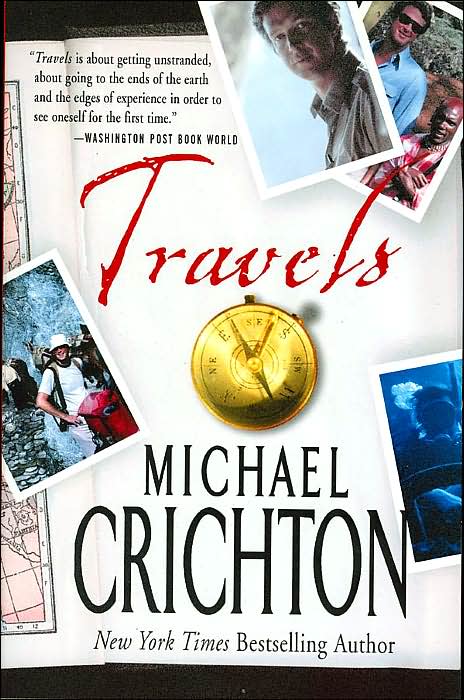
Michael Crichton: Travels

I read Michael Crichton’s autobiography Travels when it became available in paperback, so best guess 1989 or 1990. I would have been either fourteen or fifteen. I remember it being alternately powerful and boring. I inhaled the candid accounts of medical rotations, the details of his accidental evolution as a writer and of course reports on the titular travels to exotic locales like Shangri La or Papua New Guinea. The New Age explorations of auras, channeling, and astral projection did less for me. It’s possible, apparently, to be simultaneously open to them as possibilities and yet uninterested.

With used copies available on Amazon for $4 with free shipping, I thought it’d be worth seeing how Travels held up to adult scrutiny.

Structurally, the book can be roughly divided into three sections: medical school, travels and inward experimentation. He treks up mountains and through jungles, braving headhunters, elephants, sharks, and even a talking cactus while learning about human anatomy, chakras and psychics. It’s unique.

What surprised me was how close some of my presently held beliefs were to Crichton’s. In 2005, I wrote a piece entitled “Of Everything You Know to be Right and True, Only Some Is.” Which, while I never considered this at the time, could have been a subtitle of Travels.

Throughout his life, from medical school on, Crichton struggled to reconcile our absolute faith in western medicine with our dismissive attitude to traditional practices. His skepticism has been validated, to an extent, by the recent explosion of interest in reorienting the practice of medicine around evidence, or as we would call it in the technology industry, data. It’s easy to see him subscribing to the following, for example, from the New York Times:

During one of our first conversations, Brent James told me a story that you wouldn’t necessarily expect to hear from a doctor. For most of human history, James explained, doctors have done more harm than good. Their treatments consisted of inducing vomiting or diarrhea and, most common of all, bleeding their patients. James, who is the chief quality officer at Intermountain Healthcare, a network of hospitals and clinics in Utah and Idaho that President Obama and others have described as a model for health reform, then rattled off a list of history books that told the fuller story. Sure enough, these books recount that from the time of Hippocrates into the 19th century, medicine made scant progress. “The amount of death and disease would be less,” Jacob Bigelow, a prominent doctor, said in 1835, “if all disease were left to itself.”

Not that Crichton’s innate open-mindedness was confined to medicine; his novel State of Fear evinced a similar, unfortunate belief that global warming was both overstated and incorrect. Even as his arguments are eviscerated by more qualified scientists, however, it’s possible to appreciate the kind of man who would examine the available evidence and come to his own conclusions about the data rather than hew to the accepted narrative.

Did I evolve my own worldview evolved in a direct response to Travels, or would I have arrived at a similar brand of independence independently? I’m not sure what the answer to that is. Neither was Esquire’s Anya Yurchyshyn.

One of the more interesting areas of speculation involves the degree to which health may be influenced by the individual. Crichton describes the position he eventually adopted as follows:

Many years passed, and I had long since left medicine, before I arrived at a view of disease that seemed to make sense to me. The view is this: we cause our diseases. We are directly responsible for any illness that happens to us.

In some cases, we understand this perfectly well. We knew we should not have gotten run-down and caught a cold. In the case of more catastrophic illnesses, the mechanism is not so clear to us. But whether we can see a mechanism or not-whether there is a mechanism or not – it is healthier to assume responsibility for our lives, and for everything that happens to us.

There are obvious problems with this theory: no one who hears a six year old with Leukemia interviewed during the Jimmy Fund telethon, for example, is going to conclude it is somehow the child’s fault. But that doesn’t mean that the premise can’t be useful. It is, in fact, the guiding principal behind efforts like HopeLab’s Re-Mission and an equivalent developed at the University of Utah, which employ the video game metaphor to enlist patients as full and equal participants in their treatment.

And while those projects are still viewed skeptically, the concept that the mind has power over the body is uncontroversial. There is little debate about the power of the placebo effect, for example. The mind does have power over the body; what remains unclear is how much, and how that may or may not be controlled. That Crichton came to believe this during his medical education is interesting; that it was completely unaddressed by his curriculum, equally so.

Reading this book also reinforced the stark differences in the availability of information. From Google Earth to Wikipedia, reading is a fundamentally different experience than it was in 1988 when looking up the details on Kilimanjaro meant a trip to the library rather than a new browser tab.

Travels is an interesting book, an in depth look at an interesting man. Imperfect, certainly, but honest about it. His most distinguishing feature, to me, was his unapologetically open mind. This is a book that I’d recommend, and one that I’m sure I’ll be rereading every so often.

Is Education a Bubble?


My mother’s father spent the majority of his adult life working in the shipyards. He graduated at the top of his high school class, but was the eldest of ten children which meant no college. My father’s father was a scholarship student who later became an Episcopalian minister.

Neither of my parents were thus born into privilege. Both were born into households that emphasized education. You will go to the best school that you can get into, they were told, it’s your ticket to a better life. Which they did. And while definitions of better vary, my parents certainly had a higher standard of living, courtesy – in part – those educations, than their parents.

What their parents did for them, my parents sought to do for my brother and myself. In spite of rising tuition rates, we attended highly ranked, costly private institutions. That they could ill afford, truth be told.

This traditional valuation of education has lately been challenged, both on grounds of cost and of benefit. This is appropriate. We must always question and assess the validity of what we’re told, what we’ve come to believe.

Typically, to answer the question of whether costs are appropriate it is necessary to examine the question of benefits. In the case of higher education, it is not. As this graphic from the New York Times attests (the Washington Post ran a similar story), the cost of schooling has not only outpaced the consumer price index (CPI) and median family income, but healthcare. This trajectory – which has student debt approaching one trillion dollars – is unsustainable, even to the schools themselves.

My wife’s alma mater, Middlebury, last year announced its intention to cap growth of its comprehensive fees at one percentage point above the CPI. Previously, Princeton and my own alma mater, WIlliams, have frozen tuition for one year periods in response to concern about rising costs. No comprehensive solution to tuition costs is apparent at present, however.

The justifications for this escalation are unknown. It’s reasonable to expect that they are a function in part of both rising operational costs and an attempt to offset substantial market losses for hedge fund sized endowments. But as these and many other elite institutions are privately run, the simplest reason is probably this: the market bore, and continues to bear, the costs. The question is for how much longer, and what the unintended consequences are to the institution in terms of student composition.

Accepting that the costs are prohibitively high, however, criticism of the relative merits of an education are misguided.

PayPal founder Peter Thiel reignited this debate with his TechCrunch interview. Cost was his focus, but he also took exception to the idea of exclusivity.

“If Harvard were really the best education, if it makes that much of a difference, why not franchise it so more people can attend? Why not create 100 Harvard affiliates?”

Setting aside the fact that his “20 Under 20” program is itself exclusive and counter-examples such as the Harvard Extension School (disclosure: I’ve completed two classes there), which makes a Harvard education more broadly available (see this Kansas resident Harvard Masters graduate here, for example), the question is why this exclusivity exists.

The answer, to me, is scale. Distinction and achievement are necessarily rivalrous resources.

Between the birth of his father and my father the United States welcomed around thirty-four million new souls. Between mine and my father’s, the number was seventy-five million. Mine and my nephew’s, ninety-two million.

Given that talent identification has been historically, and remains in spite of the best efforts of our industry, systemically inefficient, differentiation is of critical importance in the face of long term population growth. Most employers cannot scale their hiring processes effectively. When applying for jobs my senior year at Williams, I bypassed the initial hiring screen for Anderson Consulting (now Accenture) through a friend who worked there, but my candidacy was subsequently killed because my GPA was below their minimum requirement. I understood this completely. The metric may not have been an accurate assessment of my abilities, but it was an approach that could be reproduced at scale.

One of the functions of education from the perspective of employers has been filtration. An employer hiring a graduate from Harvard or a similar institution is unlikely to able to assess on any important level whether or not the candidate is a good fit. Gaining admittance to and graduating from an elite institution is, however, a non-trivial achievement in the majority of cases. If there were a hundred Harvard affiliates, as Thiel proposes, the achievement would become non-differentiating and thus depress the value for both student and employer.

Seth Godin calls this buying a brand, and asks whether

“an elite degree deliver[s] ten times the education of a cheaper but no less rigorous self-generated approach assembled from less famous institutions and free or inexpensive resources?”

There are a variety of benefits to a so-called elite degree over free resources, from quality of instruction to the network you build. But brand is also part of that, because it provides differentiation in an increasingly crowded workplace.

Fortunately, there are many emerging opportunities for talent to stand out. Github as a resume is a wonderful concept, attacking as it does inefficiencies in the hiring process. Likewise programs like TechStars, Y Combinator, and Thiel’s own “20 Under 20”. These are excellent as far as they go. But unfortunately, these are not provide a model for non-technical industries. Nor do they address issues of exclusivity; they are, in fact, more exclusive than elite educational institutions. Y Combinator’s acceptance rate is approximately 3%, Harvard’s hit an all time low of 6.2% this year. Very few people, relative to population, are in the technology industry. Of those that are, even fewer are admitted to YC-style incubators.

The list of evidence that a college education is not a prerequisite for success is long. Besides well known non-graduates like Damon, Gates or Zuckerberg, see the college dropouts Hall of Fame. I know, work with and have immense respect for both high school and college dropouts; many of whom have accomplished a great deal more in their careers than I may reasonably expect to.

Nor is it reasonable to suggest that everyone will benefit from college: the lack of a strong vocational education system in the United States is a real problem. Both for students that are incurring debt that the education is unlikely to offset and for a job market that is thus shorted trained workers.

From a statistical perspective, however, the question is not whether you can be successful without a college education (assuming a non-vocational career path), but what the probability is that you will be. If the success rate for entrepreneurs was high, venture capitalists would be unnecessary. What are the options if you are unsuccessful? Some doors will be closed to non-college graduates.

Lost in discussion of costs and exclusivity are the soft benefits of college attendance. As I told incoming freshman this past September, much of the value of an elite education are the people you meet, what you learn from them, and the opportunities these relationships open later in life. I have counseled and helped place alums, just as they have done the same for me. Being in close proximity to intelligent and motivated kids for a four year period has value. Networking is not exclusive to education, clearly, but startup life doesn’t necessarily yield the same opportunities for networking and broad based education because of size, the stresses of the job and a necessary lack of diversity: startups tend to self-select a certain type of individual.

Ultimately, assessing Thiel’s argument that education is a bubble depends on definitions. Few would disagree that costs are disproportionate to both value and economic context at present. If this is a bubble, however, higher education must give way to an alternative education model in sufficient volume that its prices drop dramatically. It is difficult to conceive of this occurring: however imperfect the system is at present for both students and employers, would be solutions are imperfect.

Khan Academy and similar efforts, for example, may well disrupt the process of education, democratizing access to high quality resources: an effort to be applauded. But even assuming the process of educating can be disrupted by technology, the process of hiring the educated remains: if you remove the filter that colleges represent, how will employers manage the volume?

Like healthcare, the outsized rise in the costs of an education are not sustainable. But I remain unpersuaded that forgoing a college education would be beneficial to all or even most would be start up entrepreneurs.

If that’s a bubble, then, so be it.

Ken Tremendous Speaks for Me

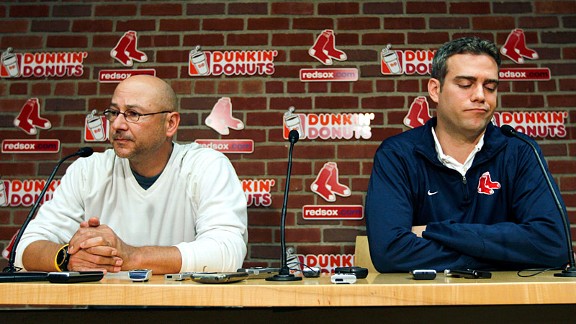
I’d like to briefly address the complete moron in the Red Sox organization who insinuated to a reporter that Terry Francona had a problem with prescription pills.

Dear Moron,

Congratulations! You have just a) attacked the best and most popular manager your team has ever had while b) displaying a complete lack of institutional loyalty, which c) pretty much guarantees that no one in his right mind will want to manage your team now, and d) turned everyone against each other causing e massive paranoia which will undoubtedly lead to f) a thousand more stories about how dysfunctional your organization is, which will only intensify the ill effects of (b,c,d,e). You are the worst person in the world. Quit.”

via Michael Schur on the Boston Red Sox – Grantland.

This Seems Crazy, Now

At its height, the Pinkerton National Detective Agency employed more agents than there were members of the standing army of the United States of America, causing the state of Ohio to outlaw the agency due to fears it could be hired as a private army or militia. Pinkerton was the largest private law enforcement organization in the world at the height of its power.”

via Pinkerton National Detective Agency – Wikipedia, the free encyclopedia.

Bless Chad Finn, AKA The Voice of Reason

The man who put this bunch together wont escape cross-examination. Theo Epstein is a tremendous general manager when common sense and context are considered, but he must be accountable for the Lackey and Crawford contracts provided the latter wasnt pushed on him by ownership desperate to boost NESN ratings. I do not want him to lose his job or bolt for the Cubs by any means; I want him to find his way out of this mess he has created. And I trust he will.

As for the manager, please dont bring those ill-considered gripes to me, the reactionary argument that someones head has to roll, that Terry Francona has gone too soft. Save the shrieking for someone else; Im going to be more infuriated if Francona leaves than I was when Papelbon threw that meatball to Nolan Reimold. Just because Francona doesnt light up his players to the media doesnt mean hes passive behind closed doors. Hes honest, funny, and sarcastic — Im sure he gets his points across. Again, please, try to keep perspective, and that goes double for anyone in ownership who wrongheadedly thinks Bobby Valentine is the solution to anything.”

via Red Sox did this to themselves – Chad Finns Touching All The Bases – Boston.com.

On Marginal Advantage and Game Theory

The marginal advantage embodies the notion that one cannot, and should not, try to “win big.” In a competitive setting, the strong player knows that his best opponents are unlikely to make many exploitable mistakes. As a result, the strong player knows that he must be content to play with just the slightest edge, an edge which is the equivalent to the marginal advantage. More importantly, a one-sided match ultimately carries as much weight as an epic struggle. After all, the match results only in a win or a loss; there are no “degrees” of winning. Therefore, at any given point in a game, the player must focus on making decisions that minimize his probability of losing the advantage, rather than on decisions that maximize his probability of gaining a greater advantage. In short, it is much more important to the expert player to not lose than it is to win big. Consequently, a regular winner plays to extend his lead in a very gradual, but very consistent manner.”

via Competitive Gaming Article by Day[9], via Donnie